THE CONTINUITY STACK
NVIDIA Did Not Raise $500 Billion. Wall Street Is Financing the Right to Keep AI Billing.

Shanaka Anslem Perera. August 18, 2026
On August 10th, 2026, NVIDIA announced agreements with Apollo, BlackRock, Blackstone, Brookfield, Goldman Sachs, and KKR to create financing platforms for AI infrastructure. The announced figure exceeded $500 billion, but it was not revenue, committed capital, a single fund, or money assigned to one customer. The memorandums of understanding remain subject to final agreements.
Eight days later, the structure is clearer. NVIDIA has said it may provide residual-value support for selected projects. It has said it will provide credit support for land, power, and shell at SB Energy’s PORTS-Pike campus in Ohio, secure an initial 4.25 gigawatts of information-technology capacity with an option over another 3.75 gigawatts, invest $1.5 billion in the developer, and serve as the site’s exclusive AI compute provider. OpenAI is expected to occupy eight gigawatts under a 20-year lease. NVIDIA is not merely supporting the resale price of aging chips. It is supporting the fixed infrastructure that allows successive generations of chips to remain installed, powered, and billable.
The executed agreement behind CoreWeave’s $8.5 billion investment-grade facility shows what Wall Street is actually financing. It is not a pile of GPUs. It is a continuity stack built from accepted customer capacity, enforceable revenue, power, site access, controlled cash, identified hardware, transferable warranties, operating rights, tax economics, rapid amortization, and any support that absorbs a shortfall. Those elements are conditional on one another. Valuable silicon cannot compensate for lost power. A strong contract cannot compensate for collateral that creditors cannot access or operate. The financeable asset is the right to keep the cluster billing after its original operator fails. This article maps the seven different credits hidden inside the AI-debt headline, the four-rung recovery ladder, the four clocks governing one machine, the route into private credit, and the disclosures that can break the argument. August 26th is the first formal test.
$500 Billion Is a Market Design, Not a Cash Balance
The proposed platforms mobilize third-party capital over time. They create neither $500 billion of orders nor cash at NVIDIA’s disposal. Each project still requires underwriting, documentation, funding, construction, power, acceptance, and a paying customer.
The announcement matters because NVIDIA is trying to make that process repeatable. An AI laboratory or cloud operator with demand but limited balance-sheet capacity can approach a financing channel already familiar with NVIDIA equipment, reference designs, deployment standards, and possible recovery support. The lender assesses the borrower and project. NVIDIA supplies the technical platform and, in selected cases, may support residual value for up to 25 percent of an opportunity.
This was not a sudden departure. On July 1, NVIDIA described a model that combines revenue sharing with credit support for AI clouds. Under that arrangement, NVIDIA earns ordinary product revenue and a share of cloud revenue generated by supported capacity. The vendor is no longer paid only when the hardware ships. It can participate in the income the hardware later produces.
That creates a legitimate commercial opportunity and a new concentration of risk. NVIDIA may invest in the customer, sell the equipment, support part of the financing, receive usage-linked income, and hold securities whose value depends on the customer’s success. None of those links makes the revenue fictitious. Together they make the source of cash more important than the name on the purchase order.
If enterprises, developers, governments, and consumers pay enough for the resulting services, the circle is open. External cash enters, debt amortizes, and NVIDIA’s support remains unused. If the principal cash source is recurring capital raised within the same ecosystem, the structure can remain liquid while the underlying economics weaken.
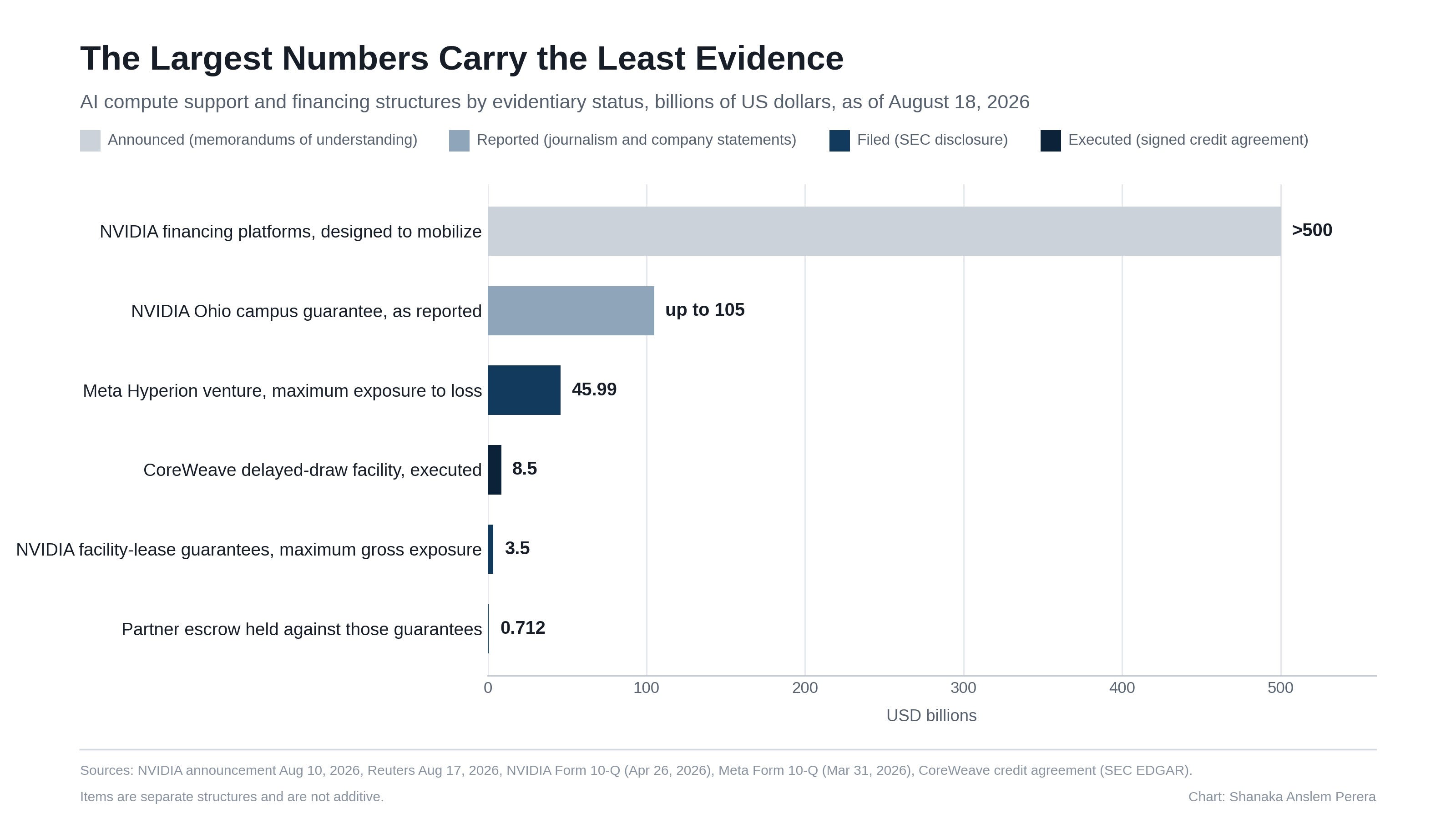
Familiar counterparties, multiple profit streams, and a famous asset manager’s signature do not answer the decisive question. Only cash generated outside the financing chain can service the capital placed inside it.
NVIDIA Is Now Supporting the Infrastructure That Cannot Be Moved
The August 17 PORTS-Pike announcement moves the financing discussion below the chip. NVIDIA said it would provide credit support for the land, power, and shell required for an initial 4.25 gigawatts of information-technology capacity. It has an option over the remaining 3.75 gigawatts. The company said OpenAI is expected to occupy the campus under a 20-year lease, with SB Energy building, owning, and operating it. The first phases are expected in 2028.
The release also states that NVIDIA will invest $1.5 billion in SB Energy and serve as the exclusive AI compute provider at the site. SB Energy and SoftBank plan at least 10 gigawatts of new generation and at least $4.2 billion of regional grid investment. Those figures describe separate pieces of the transaction. The equity investment must not be added to an undisclosed guarantee and presented as one exposure.
The public release does not disclose the maximum credit-support amount, attachment point, trigger, beneficiary, premium, recourse, collateral, settlement method, or accounting classification. Its headline uses the word guarantees. Its body says credit support. Neither phrase is enough to calculate NVIDIA’s obligation. Reuters reported that NVIDIA agreed to guarantee up to $105 billion for the eight-gigawatt campus, with the company saying the guarantee covers part of the lease and power payments plus a commitment that the site retain a minimum value. The figure and mechanics appear in journalism and company statements, not in the release or an executed agreement. Until definitive documents disclose them, they remain reported terms rather than filed obligations. That gap is central to this article.
The 20-year lease does not prove that twenty-year debt is being placed against one generation of GPUs. Land, grid access, substations, cooling, fiber, and the data-center shell can host several generations of hardware. The fixed layer may deserve longer capital than the silicon installed in it. Credit quality still depends on OpenAI’s rent, the cost of repeated hardware upgrades, the ability to place a replacement operator or tenant, and the rights that survive a default.
The announced economic linkage is now publicly visible. NVIDIA plans to invest in the developer, support the fixed infrastructure, supply the site’s compute, and benefit when OpenAI uses the capacity. Those exposures are legally distinct. Their common driver is the campus remaining occupied, powered, upgraded, and paid.
That does not prove demand is artificial. External customers can generate enough cash for OpenAI to honor the lease, SB Energy to service its obligations, and NVIDIA to earn an exceptional return. The new structure settles a narrower point. NVIDIA has not outsourced every financing risk to independent capital. It is choosing which layer to support when that commitment secures exclusive demand for its platform.
The relevant exposure is the support attached across the entire project, not a single residual percentage. Equity, credit support, residual protection, usage-linked revenue, supply commitments, and purchase contracts must first be separated by legal form and then recombined around the cash source they share. A 25 percent residual cap cannot describe the result.
Seven Different Debts Are Hiding Inside One Label
The phrase AI infrastructure debt now covers instruments that should never be analyzed as one market. Their collateral, obligors, cash sources, maturities, and failure modes are different.
Corporate bonds and convertibles are claims on the survival and cash generation of an operating company. Data-center securitizations are principally property credit, supported by land, buildings, power infrastructure, and tenant leases. Equipment securitizations place more weight on servers, accelerators, depreciation, and remarketing. Contract-backed project loans place the financed assets inside a special-purpose borrower and route customer payments through a controlled waterfall. Hyperscaler joint ventures combine equity, leases, future funding, and residual-value commitments. Vendor guarantees and credit derivatives create contingent claims against the equipment supplier. The newly announced financing platforms are not securities at all. They are origination channels through which several of those instruments may eventually be created.
Each product answers a different question. A corporate creditor asks whether the enterprise survives. A property lender asks whether the site remains occupied and powered. An equipment lender asks what the hardware can earn or recover. A project lender asks whether the customer contract pays on time and whether another operator can inherit it. A joint-venture investor asks who funds overruns, who controls remarketing, and what happens when the first lease ends. A holder of vendor protection asks where the support attaches and whether the guarantor remains strong when claims arrive.
That taxonomy changes the duration debate. A 20-year campus lease does not prove that 20-year debt has been written against one generation of GPUs. A March 2032 legal maturity does not prove that principal remains outstanding until 2032. A six-year accounting life does not reveal the economic value of the equipment in year six. A residual guarantee does not replace a customer payment unless the contract explicitly says it does.
It also changes the systemic question. Risk does not become systemic because the aggregate headline is large. It becomes systemic when similar economic exposure is held through instruments that share the same demand factor, rely on the same recovery assumptions, and are financed by holders unable to absorb a common loss. The required map therefore begins with instrument, obligor, remaining principal, cash source, legal control, support, holder, and holder leverage. Public announcements rarely disclose more than the first two.
The market is a family of credits sharing one dependency, the conversion of power and hardware into cash. That conversion must be measured transaction by transaction.
Read the Credit Agreement, Not the Headline
CoreWeave announced an $8.5 billion delayed-draw facility with A3 and A (low) ratings from Moody’s and DBRS. The floating tranche priced at SOFR plus 2.25 percent. A fixed tranche priced at about 5.9 percent. Legal maturity falls in March 2032.
The executed agreement filed with the SEC reveals the protection behind those ratings. Its fixed-rate pricing definition uses a 3.14-year weighted-average-life benchmark. Funding depends on specified conditions and customer acceptance. Cash is routed through controlled accounts and a contractual waterfall. The borrower must maintain collateral-access agreements, preserve seller warranties, identify racks and GPUs, hedge most floating-rate exposure, and protect against specified power-cost movements. Material project contracts cannot be changed freely. The debt-service coverage floor is 1.15 times, with stricter projected coverage used for certain top-up mechanics.
