The Empty Laboratory
How physics reached the edge of control and found the universe waiting on the other side

By Shanaka Anslem Perera · June 1, 2026
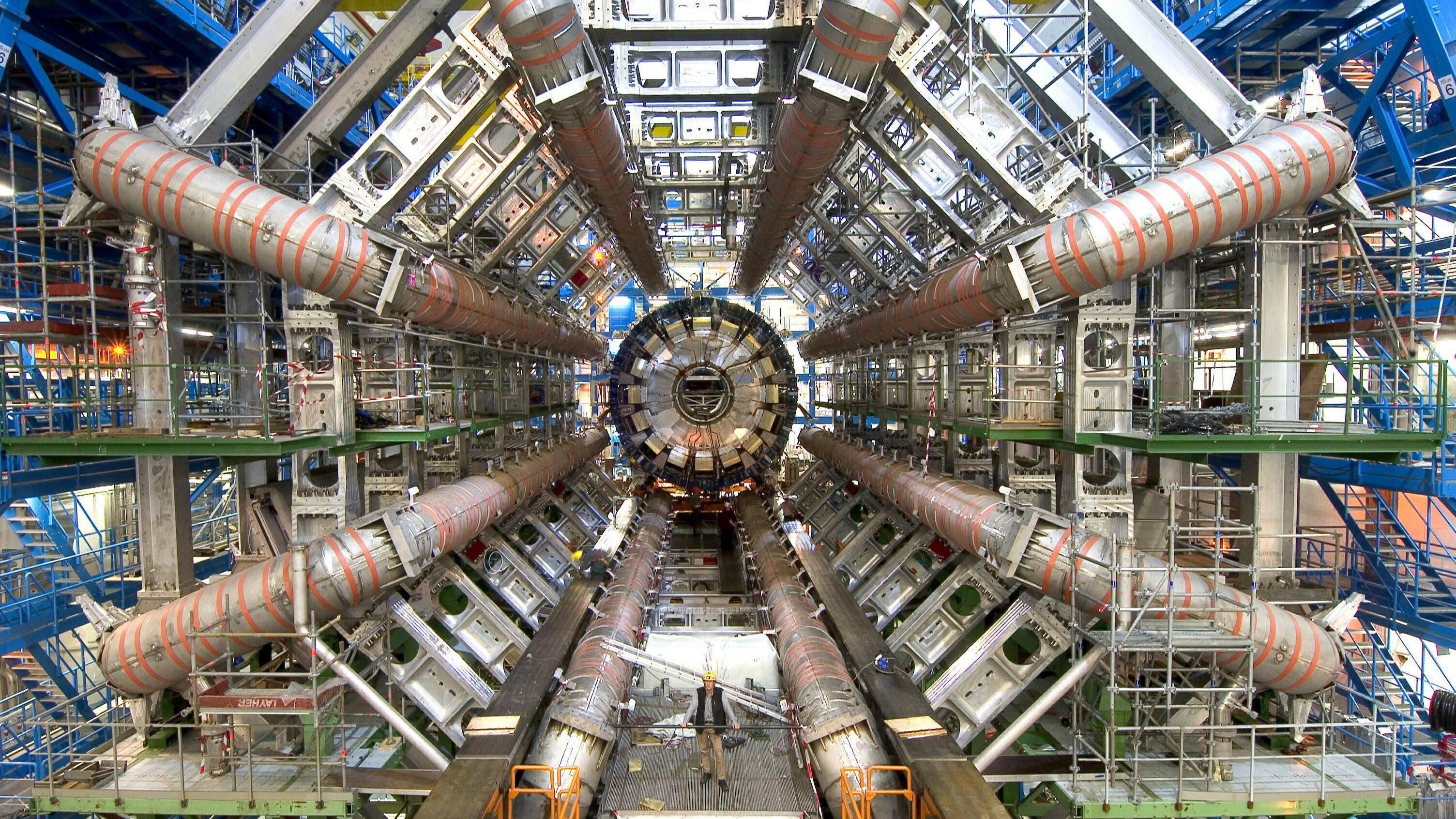
A kilometer beneath the Black Hills of South Dakota, inside a chamber of liquid xenon chilled to roughly 100 degrees below zero Celsius and buried under enough rock to strain out the ceaseless rain of cosmic particles falling on the Earth’s surface, sits one of the quietest listening rooms our species has ever built. Its name is LUX-ZEPLIN. Ten tonnes of the heaviest stable noble gas, watched by hundreds of photomultipliers and surrounded by layers of veto detectors, held in a darkness so disciplined that a single flash from a recoiling atomic nucleus can be seen, timed, and located. It was built to catch a ghost. For forty years the smart money in physics said that the universe is full of an invisible substance, that this substance outweighs everything we can see by a factor of five, and that a particle of it would, every so often, drift through all that shielding and nudge a xenon nucleus hard enough to register. The experiment was designed to feel that nudge.
In December of 2025 the collaboration reported what it had found after 417 days of watching, the largest exposure any dark-matter detector has ever assembled. It had found no ghost. What it had found instead, for the first time at real statistical significance, was the Sun. Neutrinos streaming out of the Sun’s nuclear furnace had begun striking the xenon and producing the same class of faint nuclear recoil the dark-matter particle was supposed to produce. In a detector that does not record direction, the two can overlap event by event, separable only by spectral shape, by statistics, and by techniques still to come. The quarry never arrived. The background did. The most controlled search for one of the most sought-after particles in modern physics had reached the point where the irreducible hum of ordinary astrophysics began to enter the silence it was listening into.
This is not a story about one disappointed experiment. It is a story about a pattern, and the pattern is everywhere we have the most control. For most of a century, physics ran on a single quiet equation, so reliable it never had to be spoken. To go deeper into the structure of reality was to go smaller, and to go smaller was to build a bigger and colder and more precise machine. Depth meant control, and control was something we could engineer and pay for and schedule. That equation built the deepest understanding of nature any civilization has ever possessed. And sometime after 2012, without announcement, it stopped being a safe guide to where the next answer lives.
The claim of this essay is narrow and, I think, hard to break. It is not that the laboratory has failed, that colliders were a waste, or that nothing has happened in fundamental physics since the Higgs boson. Each of those claims is false, and I will spend real effort showing why. The claim is this. The laboratory is not empty, but it is no longer sovereign over the deepest open questions. The places where we exercise the most control keep returning constraints and nulls and cooled excitements, while the live pressures on our picture of the universe arrive, increasingly, from systems we can observe but cannot touch, cannot rerun, and cannot set the initial conditions for.
There is a deeper way to say this, and it is the real argument of what follows. For most of the twentieth century, one machine could do four things at once. It could generate a new phenomenon, control the conditions that produced it, measure the result, and, in the same stroke, confirm it. The accelerator fused those acts into a single instrument. After the Higgs, they are coming apart. The sky increasingly generates the surprises. Theory translates them into claims. Laboratories adjudicate those claims under control. And concordance across independent traces decides which ones harden into knowledge. The frontier has not moved from the laboratory to the sky. It has split between them, and learning to read a split frontier is the work of the next era in physics. Underneath even that, something older is returning: physics is relearning to reason the way geology reasons about a vanished asteroid, by reading the convergent testimony of traces left behind, because the events it most wants to question can no longer be summoned into a laboratory and asked again.
When Deeper Meant Smaller
To feel the size of the change, you have to feel how total the old order was, and how earned.
The triumph at the center of twentieth-century physics is the Standard Model, the framework that names the fundamental constituents of matter and three of the four forces that bind them. It is, by any honest measure, the most thoroughly tested theory in the history of science. Parts of it, like the magnetism of the electron, have been confirmed to ten and eleven significant figures; other corners are tested far more coarsely, but the whole stands with a breadth that has no rival. It is also, viewed from a certain angle, a list of particles, assembled one by one over decades, each one predicted or discovered and then pinned down in a machine built for the purpose. The list had a famous hole in it. The theory required one more particle, a field filling all of space whose interaction with the others gives them mass, proposed in the 1960s and unfound for half a century. The hole had a name before it had an occupant. It was called the Higgs boson.
Finding it required building the largest machine ever constructed, the Large Hadron Collider at CERN, a ring twenty-seven kilometers around in which protons are accelerated to nearly the speed of light and smashed together hundreds of millions of times per second. In 2012, in the debris of those collisions, two enormous detector teams found a new particle at a mass of about 125 giga-electron-volts in the energy units physicists use, roughly a hundred and thirty times the mass of a proton. The last missing piece the Standard Model required had arrived. The theory had never fixed its mass in advance; that number was a free parameter, something nature alone could tell us. But once the particle was found, its measured properties settled, one after another, into precisely the role the theory had reserved for it. It was the purest vindication imaginable of the idea that you find what is fundamental by building a machine clean enough and powerful enough to make it appear on command.
That idea was not an accident of culture. It rested on a physical fact about the world, which is that energy and smallness are the same axis. To probe a smaller distance you need a higher energy, because in quantum mechanics a particle’s reach into the small is inversely related to its momentum. A more energetic collision resolves a finer structure, the way a shorter wavelength of light resolves a smaller object under a microscope. So the machine that reached the highest energies also reached the smallest distances, also reached, in a sense, the most fundamental layer of nature accessible to us. For most of the century, building a bigger ring bought you all three things at once: more energy, smaller scales, deeper truth. Control and reach rose together along a single line, and the line pointed straight at the foundations of physics.
There was even a compass telling the builders where to aim next. Its name was naturalness, and for thirty years it was the single most influential idea in the search for physics beyond the Standard Model. The theoretical physicist Gian Francesco Giudice, who articulated the principle as clearly as anyone, once called it the bull’s-eye of the entire enterprise. The argument runs through the Higgs. In ordinary effective-field-theory bookkeeping, quantum corrections make the Higgs mass parameter sensitive to whatever far higher energy scale completes the theory, perhaps as high as the Planck scale where gravity itself enters, as much as seventeen orders of magnitude above where the Higgs actually sits. That the Higgs stays so low looks like a knife balanced impossibly on its edge, a cancellation of huge numbers accurate to dozens of decimal places, with no reason behind it. Naturalness said there must be a reason. It said new particles must exist, not far above the Higgs in energy, whose job is to steady that knife. The most beloved candidate was supersymmetry, a proposed doubling of the particle inventory in which every known particle has a heavier partner. If naturalness was right, the Large Hadron Collider was not merely a Higgs factory. It was, more or less guaranteed, a discovery machine for a whole new world of particles waiting just past the one we knew.
That is the order that held when the LHC turned on. Deeper meant smaller, smaller meant a bigger machine, the machine was a discovery engine, and the compass said the discoveries were close. Hold that picture, because nearly every part of it is about to come apart, and the way it comes apart is the most interesting thing happening in physics today.
The Doorway That Became a Mirror
The cleanest place to watch the old order fail is not in the cosmos. It is in one of the most precise measurements ever made, of one of the smallest objects we know.
The muon is the electron’s heavier cousin, an unstable particle that behaves, as far as anyone can tell, like an electron in every way except that it weighs about two hundred times as much and decays in a couple of millionths of a second. Like the electron, it is a tiny magnet, and the strength of that magnetism is a number theory can predict and experiment can measure with staggering accuracy. The prediction is not simple. The muon is constantly surrounded by a froth of virtual particles flickering in and out of existence, as quantum mechanics allows, and each kind of particle in that froth tweaks the muon’s magnetism by a tiny amount. Measure the magnetism precisely enough and you are effectively taking a census of everything that can talk to the muon, directly or through quantum loops, including particles you have never seen directly. For decades this made the muon the most tantalizing crack in the Standard Model, because the measured value and the predicted value did not quite agree, and the gap was the right size to be the fingerprint of something new.
In June of 2025, the Muon g-2 experiment at Fermilab released its final result, the culmination of years of work, pinning the muon’s magnetism to a precision of 127 parts per billion. To picture that precision, imagine measuring the length of a football field and being uncertain by less than the width of a human hair. The measured value, for the record that experts will want, is a muon anomaly of 0.001165920705. It is one of the most precise measurements in the history of physics, a monument to control, the product of muons steered around a magnetic ring and clocked to a precision few experiments anywhere can match.
And here is what happened to the famous discrepancy. It did not survive, and the way it died is the whole point. For years the gap between theory and experiment had hovered around four to five standard deviations, the zone where physicists start to get excited, because the prediction in hand sat well below the measurement. But that prediction leaned on the single hardest part of the calculation, the contribution to the froth from the strong nuclear force, which cannot be done with pen and paper and must be wrung either out of other experimental data or out of brute-force supercomputer simulations of the equations. In the years that followed, that piece of the calculation moved. By 2026, lattice-QCD and data-informed theory updates to that strong-force contribution had brought the Standard Model’s own prediction into much closer agreement with the measurement, shrinking the gap that had looked like a doorway from a multi-sigma crack to a theory-dependent remnant whose size now turns on which calculation you trust. The anomaly that had launched a thousand speculative papers was, if not quite dead, no longer the clean signal it had seemed, and it had been brought down not by a discovery and not by a better measurement, but by a better calculation.
This is the first appearance of a theme that will return with growing force. A thirty-year hint of new physics dissolved into arithmetic. The experiment was never the bottleneck. The bottleneck was our ability to compute what the Standard Model itself predicts, and when that ability improved, the new physics receded. The doorway that everyone expected to open onto a new world turned out to be a mirror, reflecting back the limits of our own pencils. The picture is not fully settled, and saying so matters: a residual disagreement persists between the two ways of computing that strong-force contribution. But the lesson stands, and it is a lesson in humility. In the most controlled corner of physics, the binding constraint had migrated from measurement into theory.
The larger pattern this reveals is worth naming, but not yet as a map. Control is not the same as closure. An experiment can be exquisitely controlled and still depend on a theory whose hardest terms remain foggy. The muon lives at the summit of experimental control, yet its interpretation turned on the least transparent part of the Standard Model calculation. The experiment was not where the dominant uncertainty lay. The theory was the fog.
The Standard Model, in other words, did not crack where everyone was watching. It held. The interesting action moved somewhere else.
What the Silence Is Made Of
The most important result from the Large Hadron Collider, after the Higgs, is a silence. It needs to be described exactly, because it is the single fact most often abused in both directions, inflated by enthusiasts and dismissed by skeptics, and the truth is more precise and more interesting than either.
Through the years of running since 2012, across collisions at thirteen and now 13.6 trillion electron-volts, the most powerful machine ever built has found no new fundamental particle beyond the Standard Model. No superpartners. No new heavy force-carriers. None of the broadly expected new world that naturalness promised would be waiting just past the Higgs. As two ATLAS physicists put it with admirable bluntness, the absence of additional elementary-particle discoveries is, alongside the Higgs, the LHC’s main result so far, and for many physicists it is the more surprising one.
Now the correction that matters. This silence is not the same as nothing happened. The LHC has been extraordinarily productive. It found the Higgs and then measured its properties with rising precision. It has discovered dozens, and by recent counts close to eighty, new composite hadrons, fresh bound states of the quarks we already knew about, an enormous expansion of the catalog of strongly interacting matter. It has measured rare processes and tested the Standard Model in regimes never before reached. To call the laboratory empty in any literal sense is simply wrong, and any version of this argument that leans on the literal reading deserves to lose. The exact statement, the one that survives scrutiny, is this: no new fundamental degree of freedom has appeared in the place where naturalness told us to look. The machine did its job superbly. The map it was handed was mistaken.
What died, then, was not supersymmetry as a mathematical idea, and not the Standard Model, but a specific promise about where new physics had to live. Naturalness never predicted supersymmetry in the abstract. It predicted proximity. It said the physics steadying the Higgs should be close, close enough for the LHC to find or at least to corner. That is the promise that failed. In the language the philosopher Imre Lakatos gave us, naturalness as a scale-prediction programme has turned degenerative: after each failed expectation it is protected and relocated to higher masses rather than confirmed by a new prediction. Supersymmetry survives as mathematics, as a string-landscape expectation, as compressed spectra only now being probed, as a target for some future machine, and serious physicists still defend its open parameter space. But naturalness as a compass, as a sharp claim about where to point the instruments, has lost its authority. It stopped being a map and became a hope.
Return now to that quietest room in South Dakota, because it shows the same pattern from another angle. The dark-matter problem is real and overwhelming. Galaxies rotate too fast for their visible matter to hold them together; light bends around clusters as if vast unseen mass were present; the patterns frozen into the relic radiation of the early universe, the cosmic microwave background, demand it. Something is there, and the known Standard Model inventory cannot account for it. The dominant hypothesis for decades was that this something is a weakly interacting massive particle, a WIMP, precisely because such a particle would have been produced in the right abundance in the early universe and would, in principle, be catchable in a clean underground experiment. It was the perfect quarry for the old equation: deep, fundamental, and apparently buildable-for. LUX-ZEPLIN is the current peak of that effort, and it found nothing across an enormous range, even reaching for the first time into low-mass territory below nine giga-electron-volts. What it found instead, the solar neutrinos registering at four and a half standard deviations, marks the entrance to what physicists call the neutrino fog, a regime where ordinary neutrinos produce signals that mimic the dark-matter signal being hunted. The fog is not a wall and not a metaphysics; it is a measured, physical background that changes the rules of the search. But the image is exact and a little haunting. In the deepest, most shielded, most controlled search we built, the background arrived before the quarry.
Honesty has a second demand here, the opposite of the first. If I only catalog the cooling anomalies, I am selling you a tidy story, and tidy stories in physics are usually wrong. So I will put the strongest counterexamples to my own thesis in the center of the room.
The first counterexample has already cooled, and it is instructive to watch it cool. In 2022, a team analyzing old data from the Tevatron, the collider that preceded the LHC, reported a measurement of the mass of the W boson, a fundamental force-carrier, that sat about seven standard deviations above the Standard Model expectation. Seven standard deviations is enormous. If real, it was a crack in the foundations, a clear sign of new physics. The field lit up. Then, in the spring of 2026, the CMS collaboration at CERN published its own measurement of the same quantity, with comparable precision, analyzing over a billion collisions, and found a value in clean agreement with the Standard Model, 80,360.2 plus or minus 9.9 million electron-volts. The earlier result now stands isolated as an outlier, a subtle artifact rather than a discovery. Another ember, gone cold.
The second counterexample has not gone out, but its glow is harder to read than the headlines suggest, and the difficulty is the whole point. For more than a decade the LHCb experiment has studied rare decays of particles containing the bottom quark, decays in which a B meson transforms into a lighter particle while throwing off a pair of muons. These are sensitive probes; new heavy particles, too massive to make directly, could leave fingerprints in how often and in what angular pattern the decays occur. And the patterns have been off, most famously in an angular quantity called P5-prime, which has sat askew of prediction for years. But the most careful recent work cuts against the simple new-physics reading. When LHCb analyzed one such decay across its full data set and modeled, for the first time, the long-range effects of the strong force directly from the data rather than assuming them away, the suspect coupling deviated from the Standard Model by only about two standard deviations, and the global significance fell to roughly one and a half. A companion analysis of a related decay found its agreement with the Standard Model wandering anywhere from under two standard deviations to four, depending entirely on which hadronic form factors one feeds it. That last clause is the theory fog in miniature. This is still a live tension in a high-control laboratory, and I will not wave it away. But the shape of the doubt is the same one we met with the muon. The significance turns on how we model the strong force inside the decay, the contribution of so-called charm-quark loops, and the community is genuinely split on whether the residue is new physics or our own hadronic ignorance. The bottleneck, once again, is theoretical closure, not measurement.
There is a name waiting to be made here, and the LHCb case earns it. We met the neutrino fog underground, a physical background that blurs a search no matter how still the detector becomes, because nothing can shield a nucleus from a neutrino. We are now meeting its mirror image, a calculational opacity that blurs the meaning of a measurement even when the data are clean. Call it the theory fog. It is not irreducible, and that is the crucial difference: the muon shows it can lift. But it lifts only when theory becomes as disciplined as the experiment it is trying to interpret. The muon’s fog lifted, and the anomaly went with it. The LHCb anomaly is still inside the fog, and we cannot yet tell whether the shape we see is a new law of nature or a trick of the murk. What the two fogs share is the lesson. At the frontier, in the laboratory as much as in the sky, the limiting factor has shifted away from how precisely we can measure and toward how well we can interpret. The era when a sharper measurement settled the question is giving way to a harder one, where the question waits on better theory or on the convergence of independent evidence. That shift, from measurement to inference, is the hinge on which the whole migration turns.
The Sky’s Subpoenas
While the most controlled experiments have been returning silence and cooled embers, the universe we cannot touch has been doing something else. It has been raising live questions, several at once, all from instruments that can only watch.
The sharpest of these concerns dark energy, the name for whatever is driving the expansion of the universe to accelerate. The simplest hypothesis, woven into the standard cosmological model, is that it is a constant, a fixed energy of empty space itself, unchanging across cosmic time. In March of 2025, the Dark Energy Spectroscopic Instrument, an array on a mountaintop in Arizona that has measured the precise positions of more than fourteen million galaxies and quasars, released a result that put that simplicity under strain. Using the faint regular pattern in how galaxies cluster, a ruler frozen into the cosmos by sound waves in the infant universe and known to astronomers as baryon acoustic oscillations, DESI traced the expansion history with new precision. On its own, the data sit comfortably with a constant dark energy. But combined with the relic radiation of the Big Bang and with catalogs of exploding stars, the Type Ia supernovae that serve as cosmic mile-markers, the picture shifts, and the combination prefers a dark energy that was stronger in the past and has been weakening, an evolving rather than a constant force. The preference is not small. Depending on which catalog of supernovae is folded in, it runs from below three standard deviations to as high as 4.2.
This matters, and it must be stated with a precision the headlines rarely manage. The most secure single statement is the narrowest one: DESI’s baryon measurements combined with the microwave background alone, without leaning on any one supernova catalog, prefer an evolving dark energy at about three standard deviations. Every one of these numbers sits below the five-standard-deviation threshold that physics demands before it will use the word discovery, and the higher figures depend on which supernova sample is chosen, which is a sign of fragility, not robustness. The supernova significances cannot honestly be averaged or cherry-picked, and independent analyses have pushed back hard. One careful reanalysis, recalibrating one of the supernova datasets, drops the strongest 4.2 down to about 3.2. Another, recasting the question in fully Bayesian terms, finds that for the cleanest combination of data the evidence leans very slightly back toward the constant after all. The right way to hold this result is not that DESI has overturned the cosmological constant. It is that DESI has made the constancy of dark energy a live, quantitative question for the first time in a generation. To put it in the language the case deserves: DESI has not convicted the cosmological constant. It has subpoenaed it. And its force lies not in being a verdict but in being a scheduled test. Euclid, Rubin, Roman, and the final DESI analyses will, over the next several years, either turn the subpoena into evidence or file it in the graveyard.
The second subpoena concerns the expansion rate itself, and it has become subtler and more revealing than the simple crisis it is usually painted as. There are two main ways to measure how fast the universe is expanding today. One reads it from the relic radiation of the early universe, interpreted through the standard model, and gets a value near 67.4, in the usual cosmological units. The other builds a ladder of distances out into the local universe, calibrating exploding stars against nearer, well-understood stars, and gets a value near 73. The gap between them is large enough, relative to the stated uncertainties, that it should not happen by chance, and it has stubbornly refused to close for years. The James Webb Space Telescope gave both sides a sharper test, by checking whether the local ladder rested on a subtle error in crowded star fields. The team behind the high value used Webb and reported that no such error explains the gap; their ladder held, near 73. But here the story turns from a clean fight into something more unsettling. A second, independent team, using the same telescope but a different rung for its ladder, a different class of calibrating star, gets a markedly lower value, near 68 to 70, comfortably consistent with the early-universe number and requiring no new physics at all. The same telescope, in other words, yields one answer in one ladder and a different answer in another. Part of the famous tension, it turns out, does not live between the early universe and the late universe. It lives inside the local distance ladder, between rival ecosystems of calibration. That detail, the same telescope giving two answers depending on the rung, returns later as the key to the deepest part of the story.
Two more signals deserve to be named, not because they carry the argument, but because they show, more vividly than anything, what kind of frontier the sky has become. In February of 2025, a neutrino telescope on the floor of the Mediterranean Sea, then only partly built, recorded a single neutrino carrying around 220 peta-electron-volts, more than ten times the energy of anything its larger rival at the South Pole had ever seen, and the most energetic neutrino ever detected by anyone. Its origin remains unknown; it may come from a new class of cosmic accelerator, or it may be the first detection of a neutrino born from ultra-high-energy cosmic rays colliding with the relic radiation of the Big Bang. And across the same few years, arrays of astronomers monitoring the ticking of dozens of dead, spinning stars scattered across our galaxy detected a faint correlated wobble in their timing, the signature of a background hum of gravitational waves washing through the Milky Way, most likely the collective rumble of supermassive black holes spiraling together in distant galaxies over millions of years.
I want to be careful and unfashionable about these two. They are marvels. They are not, in this argument, pillars. The single neutrino is exactly that, a single event, and reconciling it with what other detectors have not seen requires it to be a roughly two-sigma fluctuation, with the tension running as high as three and a half depending on assumptions. The gravitational-wave hum is a real and beautiful detection, but its strength and its interpretation are still settling. I lean on neither to make my case. They belong here for a different reason, as the purest demonstrations of a single fact. Each of them reaches into a regime no machine we could ever build will enter, whether in raw energy or in the sheer span of space and time it crosses. These are nature’s experiments, run at energies and across spans of space and time that lie beyond anything we can schedule. They are not ours to perform. They are only ours to detect.
The energy comparison, though, is treacherous, and the fallacy it invites must be disarmed. In raw, lab-frame energy, the Mediterranean neutrino dwarfs anything we accelerate. But a cosmic particle striking matter in a detector is not the same as two controlled beams colliding head-on. Only a fraction of its energy is available to make new particles, the useful amount growing only as the square root of the collision energy, and the event arrives once, unbidden, with no dial to turn and no second run to schedule. The sky extends our reach while stripping away our control. The collider preserves our control while bounding our reach. Neither replaces the other.
Now the map can be drawn, because the whole landscape has finally come into view. This is the Control-Reach Matrix. Control asks whether we can prepare the phenomenon, vary it, repeat it, and blind ourselves against our own expectations. Reach asks whether the instrument touches the energy, distance, timescale, density, or cosmic epoch where the question actually lives. The accelerator century was the rare interval in which those two axes rose together, so that a single machine could have both at once. The post-Higgs frontier begins when they separate. A collider gives maximal control with bounded reach. A cosmological survey gives enormous reach with almost no intervention. A dark-matter detector or a neutrino telescope sits between them, built like a laboratory and operated like an observatory, waiting on nature to provide the event. Lay one more thing over that map, the theoretical closure we met with the muon, and the predicament is complete: even a perfect measurement can be trapped in theory fog, and even a magnificent concordance can fail if its witnesses are not independent. Control, reach, closure. The trade-off among the three is the geometry of the whole moment, and it is why the frontier has not simply moved from the bench to the sky but has split in two.
How to Know What You Cannot Repeat
Step back from the individual results and ask what they have in common, because the answer is the real subject of this essay, and it is not a fact about dark matter or dark energy. It is a fact about knowledge.
The deepest open questions in physics no longer gather in the high-control, high-reach corner the accelerator century taught us to expect. Some are almost purely observation-dominated: dark energy, the cosmic initial conditions, primordial gravitational waves, the expansion history, the large-scale structure of the universe. We cannot prepare any of these in a flask, cannot rerun the Big Bang, cannot vary the one experiment that produced the only universe we have. Others are interface questions: dark matter, the absolute neutrino mass, the violation of matter-antimatter symmetry, the existence of hidden sectors, where the first clue may come from the sky or from a rare natural flux, but the answer may still demand a laboratory. What these questions share is not that the laboratory has no role. It is that first contact can no longer be assumed to come from the system we control most. That is the precise and defensible sense in which the laboratory has lost its sovereignty. Its sovereignty was never over knowledge as such. It was over the systems we could command, and the frontier has wandered partly out of that territory.
So how do you do rigorous science about something you cannot rerun? The question sounds like a trap, an admission that you have left science behind. It is not, and the reason why is one of the most undervalued insights in the philosophy of science. The fields that have always studied the unrepeatable past, geology, paleontology, evolutionary biology, are not soft cousins of the experimental sciences. They are rigorous in a different way, and the philosopher Carol Cleland has given the clearest account of how. Their power rests on a deep asymmetry built into the structure of time itself, an asymmetry rooted ultimately in the second law of thermodynamics. A past event does not leave a single trace. It leaves a profusion of them, scattered widely and largely independently across the present. The present, in Cleland’s phrase, overdetermines the past. There are far more clues lying around than would be strictly necessary to infer what happened. And that overabundance is precisely what makes the unrepeatable knowable, because a single decisive trace, a smoking gun, can discriminate between competing stories about a past that can never be summoned back for questioning.
The textbook case is the death of the dinosaurs. No one can rerun the end of the Cretaceous. Yet we know, with a confidence that approaches certainty, what happened, and we know it through convergent traces of utterly different kinds. In 1980, the Alvarez team found a thin global layer of iridium, an element rare in the Earth’s crust but common in asteroids, laid down exactly at the extinction horizon. Then came shocked quartz, its crystal structure deformed in a way that only an immense impact can produce, found at the same layer around the world. Then, buried under the Yucatan, the crater itself, the right age and the right size. A geochemical anomaly, a mineral signature, and a hole in the ground, three independent witnesses with no reason to agree, all testifying to a single cause: a ten-kilometer asteroid. Nobody repeated the impact. The traces convicted it. That is historical science at full power, and it is not one bit less rigorous than an experiment. It is rigor of a different shape.
Now look again at how cosmology actually establishes its standard model, and you will see that it has been doing this all along. The model’s authority does not come from rerunning the universe. It comes from concordance, from the fact that wildly different probes, the relic radiation of the Big Bang, the clustering ruler of galaxies, the abundances of the lightest chemical elements forged in the first minutes, the bending of light by mass, the brightness of exploding stars, all converge on the same handful of numbers. It is the dinosaur argument written across the whole sky. Independent traces of a past we cannot repeat, converging on a common cause. Fundamental physics, at its frontier, has been reasoning like geology for longer than it has admitted.
But the deepest sciences demand that we state the failure mode of their own best methods, and here is the one that makes this argument honest rather than triumphant. The power of convergent traces depends entirely on the traces being independent. The dinosaur case is overwhelming because iridium chemistry, quartz crystallography, and crater geophysics have nothing to do with one another; they cannot all be wrong in the same direction by accident. But cosmology’s probes are not always so cleanly separate. Many of them are interpreted through the same underlying model, share the same assumptions, lean on the same calibrations. And when witnesses have been coached by the same model, their agreement may reflect the coaching rather than the truth. This is not a hypothetical worry. It is, I think, exactly what the Hubble tension has started to expose. Recall that part of that tension turned out to live inside the local distance ladder, between rival calibrations using the same telescope. That is what it looks like when two witnesses thought to be independent are made to testify separately and disagree. A tension between probes is not an embarrassment to be explained away. It is the most valuable thing a concordance can produce, because it is the discovery that the independence we assumed was not as clean as we hoped. The current tensions in cosmology are not signs that the historical method is failing. They are that method working exactly as it should, stress-testing whether the traces are truly independent or have been quietly reading from the same script.
The analogy has a limit, and the limit is worth stating plainly, because pushing past it is where this kind of argument usually overreaches. Geology and paleontology reconstruct past events using physics we already know. The laws are fixed; only the events are in question. Cosmology, at its deepest, is sometimes trying to infer the laws or the constituents themselves, what dark energy is, what dark matter is made of. The analogy is not that cosmology is geology with galaxies. It is that both become rigorous only when their traces are independent enough to discipline the model that interprets them. That transfer is strongest where cosmology infers events and parameters and source populations, and weaker where it reaches for entirely new fundamental law. I am claiming the strong version only where it is earned, which is most of the territory but not all of it.
The pieces now assemble into a single picture of how physics produces durable knowledge at this frontier, and the picture has a shape. It is a division of labor, a split between functions that the great accelerators of the twentieth century had fused into one. In the old order, a single machine generated the surprise and confirmed it in the same stroke; the collision that produced a new particle was also the proof of it. That fusion has come apart. Now a survey or a telescope or a cosmic accident, high in reach and low in control, throws up an anomaly. Then theory and computation translate that raw signal into a precise claim, and this is where the theory fog lives, where the same data can mean three standard deviations or four depending on the model. Then the high-control instruments, the colliders and underground detectors and precision experiments, adjudicate the bounds, disciplining the cosmic claim against clean terrestrial measurement. And finally the claim becomes knowledge only when independent traces converge, and only if those traces are genuinely independent in the dinosaur sense rather than coached by a shared model. Generation, translation, adjudication, stabilization. The frontier has not moved from the laboratory to the sky. It has split between them. This is what the Empty Laboratory really is: not a story of replacement, but the birth of a split frontier, on which the sky increasingly generates, the laboratory increasingly adjudicates, and concordance decides.
There is a beautiful historical irony folded into all this, which is that the sky is not a new frontier for particle physics at all. It is the original one. Before there were accelerators, there were cosmic rays, and the entire early catalog of fundamental particles was read out of the heavens. The Austrian physicist Victor Hess discovered cosmic radiation in 1911 and 1912 by carrying detectors aloft in balloons, up past five thousand meters, where he found the radiation increasing rather than fading, proof it came from above. The antimatter electron, the positron, was found in cosmic rays in 1932. The muon, the very particle whose magnetism we met earlier, was found in cosmic rays in the late 1930s. The pion in 1947, the first strange particles in the same years, all of them gifts from the sky, caught in cloud chambers and photographic emulsions on mountaintops, before a single particle accelerator of the modern kind existed. Then, in the 1950s, the accelerators arrived and domesticated the frontier. The accelerator was the machine that turned cosmic accident into laboratory grammar. For the first time the energies of interest could be produced on demand, on a schedule, under control. The era of the great machines, running from the 1950s to the discovery of the Higgs in 2012, was not the natural and permanent shape of physics. It was an interregnum, a parenthesis, a span of decades during which the reach we could build happened to exceed the reach the sky offered under our control. The closing of that parenthesis is the moment we are living in.
But it is a spiral, not a circle, and the distinction matters enormously, because it is the difference between progress and mere return. The cosmic-ray era found particles, the same kind of thing the accelerators would later manufacture by the billion. The sky we are turning back toward is not offering the same questions at a more primitive stage. It is offering deeper ones. The dark sector, the behavior of gravity, the structure of spacetime, the initial conditions of everything, these are not questions the cosmic-ray pioneers could even have posed. The frontier is not returning to its starting point. It is returning to the sky for higher questions than the sky was ever asked before. What lies on the other side of the parenthesis is not the past. It is a place we have never been.
The Graveyard, and the Live Ember
A thesis like this one carries an obligation that most grand narratives in popular science quietly evade. It must say, in advance and without flinching, what would prove it wrong. And it must show that it is not built on the kind of evidence that has fooled physicists before.
Begin with the second obligation, because physics keeps an unusually honest graveyard, and walking through it is the best inoculation against wishful thinking. In 2011, an experiment called OPERA announced that neutrinos had traveled faster than light, a result that would have overturned Einstein. It was a loose fiber-optic cable. In 2014, the BICEP2 collaboration announced the detection of gravitational waves from the universe’s first instant, a signal that would have confirmed cosmic inflation directly. It was dust in our own galaxy. In 2015, both great LHC detectors saw a bump in their data near 750 giga-electron-volts, a hint of a new particle that launched hundreds of theoretical papers within months. It was a statistical fluctuation, and it vanished with more data. To these we can now add the two we have just watched cool: the CDF measurement of the W-boson mass, and the new-physics reading of the muon’s magnetism. Each of these was, for a season, more exciting than anything I have leaned on as a pillar. Each evaporated.
This is why the argument here rests where it does. It does not rest on any single thrilling anomaly, because the graveyard is full of single thrilling anomalies. It rests on the firm nulls, on the cooled embers, and on the slow, sober accumulation of below-threshold tensions, all pointing the same direction, which is away from the old assumption that the next surprise would be generated under our control. A thesis built on the 750 giga-electron-volt bump would be dead now. A thesis built on the pattern of constraints and migration is not, because a constraint does not vanish the way a bump does. It hardens into a boundary condition.
Now the first obligation, stated as sharply as I can make it. The central wager of this essay, that the next paradigm-level surprise will come from the sky rather than the bench, can be cleanly falsified. If, within the next ten to fifteen years, a controlled or hybrid terrestrial experiment delivers a real, cross-checked, five-standard-deviation discovery of physics beyond the Standard Model, the wager loses. That could be a direct detection of a dark-matter particle, confirmed across different targets or by its annual modulation. It could be a new force or a new particle pinned down at a collider. It could be a clean signal in a precision experiment hunting for a permanent electric tilt to the electron’s charge. And, most pointedly, it could be the resolution of those LHCb decay anomalies into a real new particle, once the theoretical fog around them lifts. I have put that live ember at the center of this essay precisely because it is the strongest thing that could prove me wrong, and intellectual honesty means naming your most dangerous counterexample rather than burying it. The wager does not require a hundred-trillion-electron-volt machine to be settled. A single clean laboratory surprise would do it.
The deeper structural claim is harder to kill, and the difference is important. Even a new collider particle would not, by itself, overturn the claim that the deepest questions now live in uncontrollable or interface systems, because discovering one new particle does not make dark energy controllable, or let us rerun the Big Bang. The structural claim falls only if a controlled experiment truly cracks one of the deep cosmic questions, if someone brings dark energy or quantum gravity under laboratory command in a way I cannot currently imagine. And the whole edifice collapses only if several independent things fail at once: a laboratory discovery of new physics, and cosmology settling back onto a constant dark energy, and the Hubble tension dissolving into a shared local error, and the ultra-high-energy messengers turning out to come from ordinary sources after all. That conjunction is what the thesis bets against. Structures fall when many supports fail together, and betting against the simultaneous failure of all of them is a very different and much safer bet than betting on any one.
One more concession is owed, and it is the one that keeps the whole argument from tipping into the very overreach it warns against. The laboratory remains sovereign over several interface questions, and the neutrino is the cleanest example. The KATRIN experiment, by precisely weighing the energy of electrons emitted in radioactive decay, has placed the tightest direct limit on the mass of the neutrino, below 0.45 electron-volts, a measurement that depends on nothing but energy and momentum conservation, owing nothing to any cosmological model. That cleanliness is exactly the point: where the cosmic bound on neutrino mass is tangled up with assumptions about dark energy, the laboratory bound stands alone and unentangled. And the next great neutrino experiment, DUNE, will fire neutrinos and antineutrinos hundreds of miles through the Earth to ask whether they behave differently, a question that bears directly on why the universe contains matter at all, and it will ask it under full laboratory control. The thesis is not that terrestrial physics is finished. It is that the frontier as a whole has migrated, while specific deep questions, the neutrino’s above all, remain firmly in the laboratory’s grip. A claim that ignored KATRIN and DUNE would be a slogan. The claim that survives them is a description.
The Instruments We Choose
A civilization reveals what it believes about knowledge by the instruments it chooses to build, and the ones it chooses to abandon. In the middle of this decade, the choices became unusually stark, and they make the abstract argument here suddenly concrete and consequential.
In July of 2025, the United States Department of Energy and the National Science Foundation jointly withdrew support for CMB-S4, the next-generation experiment to map the relic radiation of the Big Bang, a project costed near 800 to 900 million dollars. This was not a fringe proposal. It had been ranked among the very highest priorities for new facilities by the field’s own federal prioritization process, and highly by the astronomers’ decadal survey. It was designed to deploy twenty-one telescopes and more than half a million superconducting detectors at the South Pole and in the high Atacama Desert, to hunt for the faint imprint of gravitational waves from the universe’s first instant, the most direct test of cosmic inflation ever attempted. It was cancelled not because the science had obviously weakened, but amid budget pressure and the rising cost of its polar and high-desert infrastructure, with the agencies pivoting toward smaller upgrades of existing instruments. The largest planned expansion of a neutrino observatory at the Pole has been caught in the same squeeze.
At nearly the same moment, on the other side of the ledger, CERN completed the feasibility study for its proposed successor to the LHC, the Future Circular Collider. Its first stage, an electron-positron machine in a tunnel ninety-one kilometers around, is estimated at around fifteen billion Swiss francs over roughly twelve years. And the way that machine is now justified is itself a piece of evidence for everything I have argued. It is presented not as a guaranteed discovery machine, the way the LHC once was, but as a precision factory, an instrument to measure the Higgs and the heaviest known particles with exquisite accuracy and to search for tiny deviations. The rhetoric has already shifted from discovery to precision, from generating surprises to adjudicating them. A decision on whether to build it is expected around 2028. A far more expensive proton-collider stage, aimed at the energy frontier, would follow only decades later.
I do not raise this fork to argue a budget. I raise it because every instrument a civilization builds buys an epistemic function. Some generate surprises by opening regimes of energy or scale we have never seen. Some stabilize a class of evidence by mapping a single frozen record with overwhelming care. Some adjudicate claims by imposing control and precision. The question is not collider versus telescope. It is whether the portfolio matches the new division of labor, and right now the portfolio is uneven: some survey generators are launching, one major primordial-signal stabilizer has been shut down, and the next great collider is being justified increasingly as a precision adjudicator with discovery potential. There is a limit even here, though, a place where economics and epistemology converge rather than compete. The reason we cannot build a machine to reach the deepest scales is not only that we will not pay for it. It is that at those scales the required machine grows so large that cost rises toward the impossible exactly as the controllability of the target falls toward zero. Money and physics push in the same direction. Even unlimited wealth could not build a collider to probe the Planck scale or rerun the Big Bang.
What stands against the cancellations is a calendar. Europe’s Euclid space telescope, built to map the geometry of the dark universe across billions of years, is releasing its first major tranche of cosmology data in October of 2026. The Vera Rubin Observatory in Chile, which captured its first images in June of 2025, is beginning a ten-year survey that will record the entire southern sky every few nights, an unprecedented time-lapse of the cosmos. The Nancy Grace Roman Space Telescope is being readied for launch in the window from late 2026 to mid-2027. Further out wait the next neutrino observatories and a vast new array to catch the highest-energy light in the universe. Some of these are funded instruments with dates; others are staged ambitions whose fate will itself test whether the portfolio truly matches the new epistemology. Either way, they are precisely the machines that will confirm or break the dark-energy signal, sharpen or dissolve the Hubble tension, and either find the sky’s surprises or fail to. The real question for the people who allocate a civilization’s scientific resources is not whether to fund colliders or telescopes. It is whether the portfolio of instruments we are building matches the new division of labor. That may be the right bet or the wrong one. It is, unmistakably, a bet about where knowledge now comes from.
Ours to Read
For a hundred years, physics obeyed a rule so successful that it hardened into an instinct. To understand the world more deeply, go smaller. To go smaller, build a bigger machine. That rule found the constituents of matter, assembled the most thoroughly tested theory in the history of science, and, in 2012, captured the last particle the theory required. The rule has not been repealed, and the laboratory that embodies it remains the only place on Earth where a slippery cosmic claim can be pinned against a clean, repeatable, controlled measurement. The neutrino alone is proof that terrestrial sovereignty endures wherever the question is rightly shaped for it.
But the frontier has walked into country the rule cannot reach. Dark energy will not be cornered in a tunnel. The first instant of the universe left its evidence written once, across the sky, and nowhere else. The most energetic particles arrive unbidden and unrepeatable, once in a great while, from accelerators no engineer will ever build. For questions like these, physics is quietly relearning a way of knowing that geology and paleontology mastered long ago, gathering the scattered, independent traces of an unrepeatable past and asking what single cause could have left them all, while testing, with the appropriate suspicion, whether those witnesses are truly independent or have been coached by the same story. The most reductive science we have, the science of the smallest things, is taking up the methods of the most historical sciences we have, and it is doing so not in retreat from rigor but in pursuit of it, because rigor, at this frontier, now looks like concordance rather than repetition.
There is a way of hearing the title of this essay as a lament, and that hearing is wrong. The laboratory is not empty because physics failed. It is empty of the particular answers it was built to expect because physics succeeded so completely. The great machines did their work so well that they cleared the near field of the unknown and pushed the remaining mysteries outward, to scales we cannot build for and to a single frozen cosmic past we cannot replay. The silence in the most controlled rooms on Earth is not the sound of a discipline running out of questions. It is the sound of the questions migrating to where we cannot follow with our hands, only with our eyes and our reason.
A kilometer under South Dakota, one of the quietest rooms we ever built waited for a ghost and heard the Sun instead. It is tempting to read that as failure. Read it the other way. The instrument was so good, so still, so deeply shielded, that it began to hear the universe leaking in from outside, the faint testimony of a star eight light-minutes away arriving in a chamber meant to be sealed against the cosmos. That is the shape of the whole moment in physics. We built our finest instruments to interrogate nature on our own terms, in our own time, on a schedule we set. And nature answered, as it always eventually does, on its own. The empty laboratory is not the end of physics. It is the moment physics discovers that the universe does not owe its deepest answers to the kind of evidence we find most comfortable. Some experiments were never ours to perform. They were only ever ours to read.
Shanaka Anslem Perera. All Rights Reserved. June 2026
Excellent essay. A very lucid account of the current state of physics research.