The Gated Corridor
Russia Is Not Absorbed. Russia Is Priced Through China.

How sanctions turned convertibility from a currency property into a diplomatic permission structure
Shanaka Anslem Perera | Friday, May 15, 2026.
There are weeks when an emerging architecture stops being theoretical and becomes observable. This was one of them.
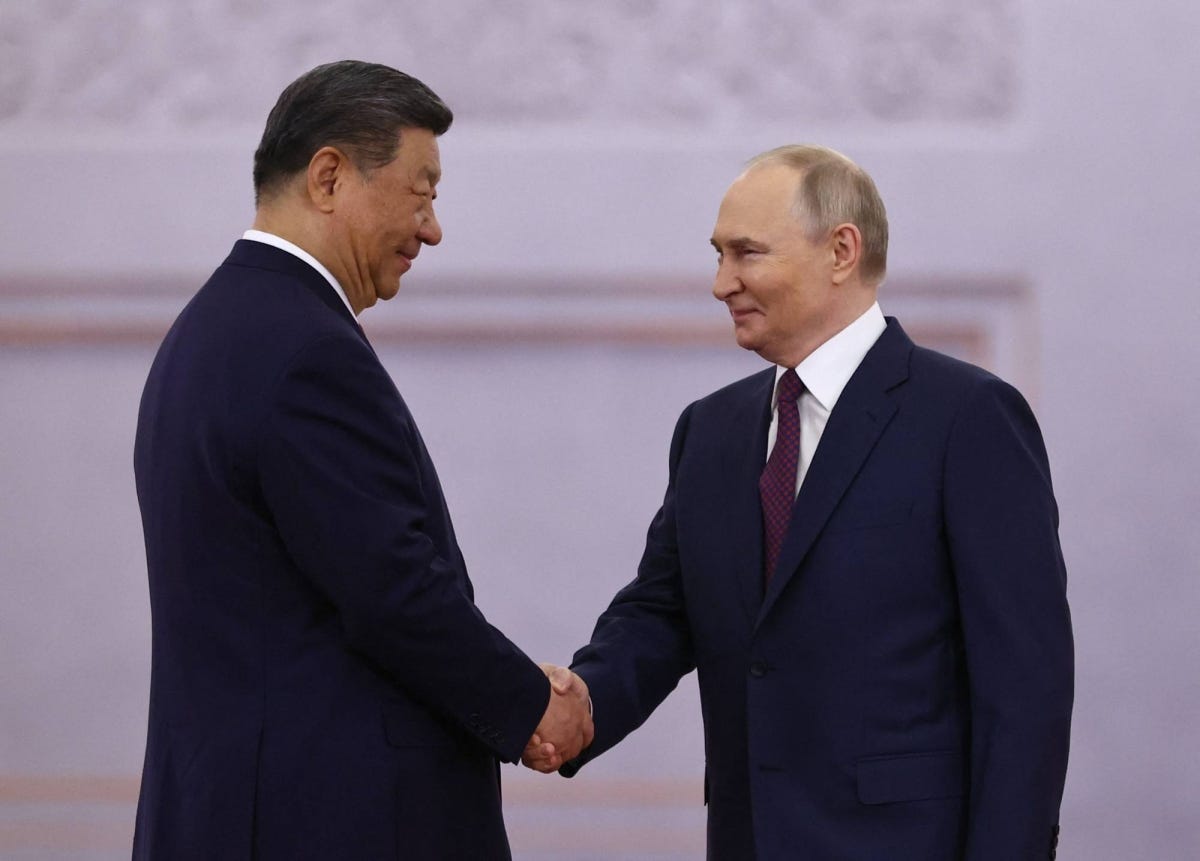
Nothing was signed in Beijing. No joint communique issued from the Great Hall of the People. The New Development Bank’s 11th annual meeting in Moscow produced no banner-draped declaration restoring Russia to multilateral financing. The Russian president’s expected follow-on visit to Beijing, reported for the week ahead, is the next discriminator rather than a coronation already priced. The architecture revealed itself not through theatre but through what theatre was absent. Three nuclear-armed sovereigns met or queued in the same capital this week. The most important fact about each meeting was the thing each meeting did not contain. The American and Chinese presidents did not bracket Russia. The multilateral lender did not restart Russia lending. The Russian president was scheduled into the same city as his strategic competitor and given no ceremonial floor. The room was sized for two. The third was queueing.
Institutional capital has been told one of two stories about Russia and China for fifty months. The maximalist story says Russia has been absorbed into a Chinese client state, a post-dollar financial architecture is now operational, and the May cluster completes the irreversible eastward migration. The minimalist story says nothing structural has changed, sanctions are working, the Russian economy is rotting, and periodic Sino-Russian theatricals are window-dressing on a contained crisis. Both stories are wrong in the same way. Both stories miss the same architectural fact.
Russia is not absorbed. Russia is gated.
The Chinese state has not constructed a sovereign rescue facility. It has constructed a corridor with a turnstile. The turnstile is enforced through People’s Bank of China policy, state-bank risk tolerance, and the compliance posture of China’s major state-owned commercial banks: Industrial and Commercial Bank of China, Bank of China, China Construction Bank, and Agricultural Bank of China. The toll rate is the spread between the overnight ruble-yuan swap rate and the onshore CNY funding rate. In March of this year, that toll rate became explicit. The Moscow Times captured overnight ruble-yuan swap stress moving from the mid-single digits into the 20% zone in mid-March, while Reuters subsequently reported Governor Elvira Nabiullina saying yuan swap rates had surged above 40% during the same stress episode. The exact print varies by date and instrument. The mechanism does not. Yuan liquidity inside Russia became scarce enough for the Bank of Russia to propose mandatory yuan reserves for commercial lenders. Yuan inside Russia is convertible only at the price Beijing chooses to make it. This is not a sovereign Russia transacting with a sponsor China. This is a gated Russia transacting through China at a price set in Beijing.
Allocators positioned for the maximalist story have bought the wrong gold thesis. Allocators positioned for the minimalist story have missed the gold thesis entirely. The architecture is precise. It may be the most important macroeconomic development since the collapse of Bretton Woods, conditional on whether the corridor scales beyond Russia. Russia is the first G20-scale, nuclear-armed sovereign to be priced this explicitly by another sovereign for the privilege of monetary continuity. It is the prototype for a post-Bretton-Woods architecture in which convertibility is no longer a property of currencies but a property of bilateral diplomatic relationships. The architecture has been built. The May cluster is the week the institutional world received enough simultaneous evidence to read it.
The Toll Booth in Beijing
The Cross-Border Interbank Payment System handled RMB 175.49 trillion of value in 2024 per CIPS disclosures, with reporting through 2025 indicating continued expansion of both throughput and participant count from a baseline of at least 176 direct and 1,514 indirect participants by mid-2025. The South China Morning Post and Shanghai Securities News reported a single-day CIPS record near RMB 1.22 trillion in March 2026, attributed in part to Middle East conflict-driven settlement demand. Standard Chartered’s Ding Shuang attributed the spike to the Middle East conflict acting as a catalyst.
