THE INVERTED PANOPTICON
Beijing Weaponized the West’s Own Wiretap Infrastructure to Execute the Greatest Intelligence Coup Since Cambridge Five
Shanaka Anslem Perera | January 27, 2026
The four trillion dollars in institutional capital positioned for stable UK-China relations rests on an assumption that died in a Chengdu server room sometime around 2019. The assumption is that espionage between major powers operates within understood boundaries, that telecommunications infrastructure is contested but not compromised, that the surveillance systems Western governments built to watch their citizens cannot be turned around to watch them. The assumption has been falsified. What follows is the complete mechanism of how China’s Ministry of State Security achieved persistent access to the private communications of three British Prime Ministers’ closest advisers, the phones of a US President-elect, and the wiretap systems that were supposed to catch them doing it. The positioning implications are immediate. The framework is permanent.
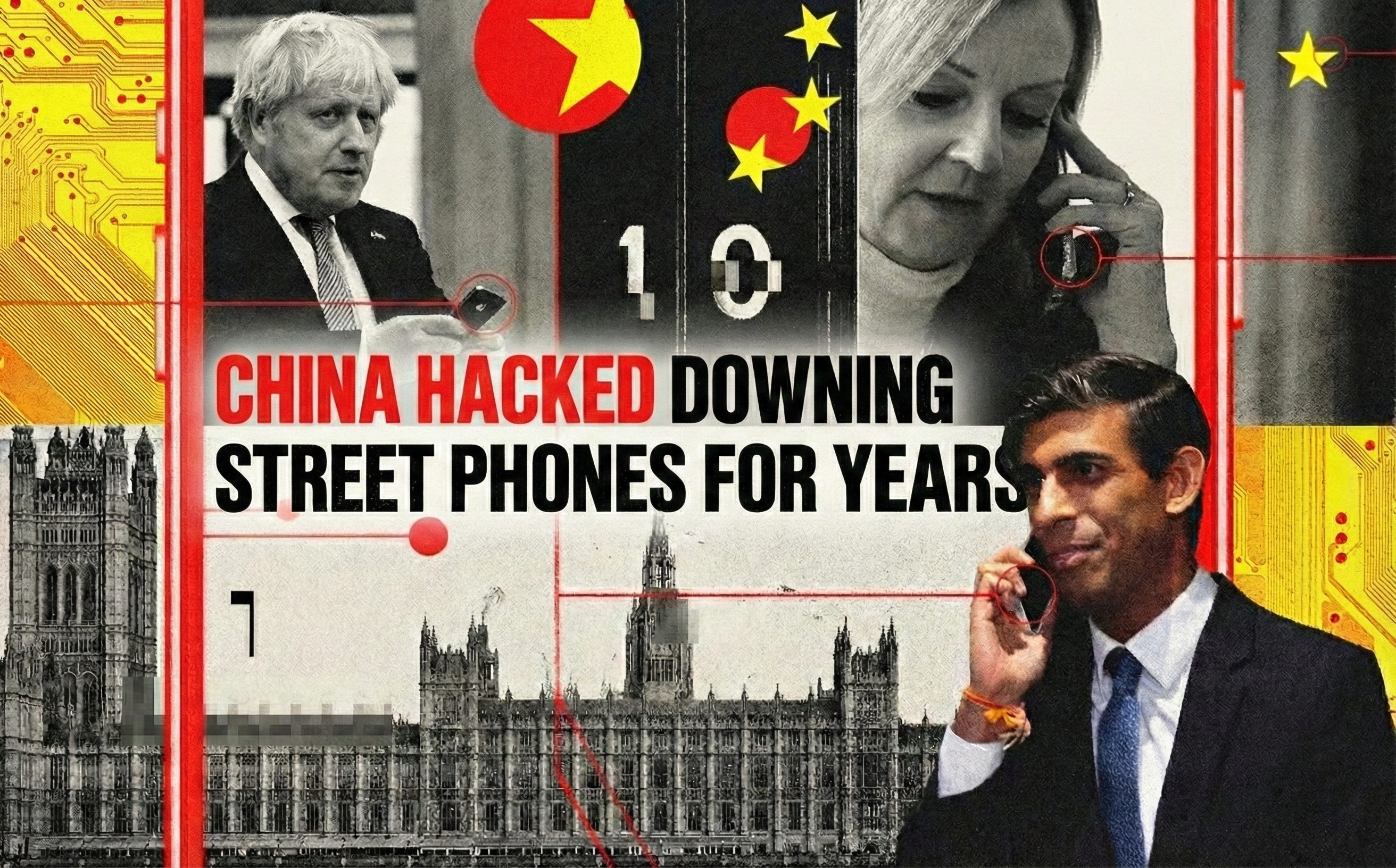
On January 26, 2026, The Telegraph disclosed that Chinese hackers had penetrated right into the heart of Downing Street, compromising mobile communications of senior officials across the Johnson, Truss, and Sunak administrations. The story was buried on page seven, treated as a technology curiosity. It was, in fact, a solvency event for the Western intelligence alliance. Not because phones were hacked, which happens, but because of how they were hacked: by weaponizing the very surveillance infrastructure that Western governments mandated for their own intelligence agencies. The Communications Assistance for Law Enforcement Act in the United States and the Investigatory Powers Act in the United Kingdom require telecommunications carriers to build backdoors into their networks for court-ordered wiretapping. Chinese state hackers found those backdoors. And walked through them.
The intelligence value is almost impossible to overstate. For approximately four years, operators linked to the MSS’s Chengdu bureau had the capability to see not just who British officials were calling, but whom the FBI was investigating, which Chinese operatives were under surveillance, what the United States knew about Beijing’s activities, and when counterintelligence was getting close. They could geolocate millions of individuals. They could record phone calls at will. They compromised the surveillance of their own surveillers, achieving the counterintelligence equivalent of reading the other side’s playbook while the game was in progress.
What follows is the institutional playbook. The positions are already being built.
The Backdoor That Swung Both Ways
The story of Salt Typhoon is not fundamentally a story about hacking. It is a story about architecture. Specifically, it is a story about what happens when governments mandate that their surveillance systems include single points of failure, then assume those points will only fail in their favor.
In 1994, the United States Congress passed the Communications Assistance for Law Enforcement Act, requiring telecommunications carriers to design their networks with built-in capabilities for government wiretapping. The law emerged from FBI concerns that digital switching technology would render traditional surveillance impossible. CALEA’s solution was elegant in its naivety: force every carrier to build a standardized interface through which law enforcement could access communications pursuant to court order. The interface would be secure because it would be secret, protected by access controls, audited by compliance regimes. No adversary would find it because no adversary would know to look.
Twenty-two years later, the United Kingdom enacted the Investigatory Powers Act 2016, colloquially known as the Snooper’s Charter. It went further than CALEA, mandating that technology companies retain communications data and provide access mechanisms for intelligence agencies. The architecture was the same: centralized access points designed for authorized users, protected by the assumption that authorized users would be the only ones using them.
Salt Typhoon was the adversarial audit that the system failed.
The Chinese operators did not need to hack individual phones, which would have been noisy and detectable. They did not need to intercept communications in transit, which would have required breaking encryption. They hacked the wiretap system itself. Once inside the CALEA infrastructure at AT&T, Verizon, and Lumen Technologies, they had access to everything the FBI had access to: call metadata showing who contacted whom and when, geolocation data derived from cell tower triangulation, the actual content of unencrypted calls and texts, and most devastatingly, the database of active surveillance requests. They could see whom the United States government was watching. They could see if they themselves were being watched.
The vulnerability was not a bug in the architecture. It was the architecture.
For decades, cryptographers and privacy advocates warned that there is no such thing as a backdoor only good guys can use. A vulnerability is a vulnerability. If it exists, a sufficiently motivated and resourced adversary will find it. The NSA and GCHQ and FBI dismissed these warnings as theoretical, academic, disconnected from operational reality. Law enforcement’s access needs are legitimate. But Salt Typhoon demonstrated empirically that the risks of mandated backdoors extend to everyone, including the governments that mandated them.
The irony approaches the unbearable. As Salt Typhoon was being discovered in late 2024, the UK government was pressuring Apple to weaken iMessage encryption under the Investigatory Powers Act. The argument was the same one that produced CALEA: law enforcement needs access, and carefully controlled access can be kept secure. Apple reportedly disabled certain features for UK users rather than comply. At precisely the same moment, as The Telegraph would later reveal, Chinese operators were reading communications from the heart of Downing Street through the access points the UK government had mandated.
The technical community has a name for this: the security paradox. Systems designed to enable surveillance become targets for adversary surveillance. The more access points you create for your own agencies, the more attack surface you expose to foreign agencies. The debate between security and privacy was always a false binary. The real tradeoff was between surveillability by your government and surveillability by everyone’s government.
Salt Typhoon collapsed that tradeoff into a single devastating data point.
The Kill Chain That Cannot Be Killed
Understanding what happened requires understanding how telecommunications networks actually function, not how they appear in policy documents.
A modern telecom network is not a monolithic system but a layered architecture spanning edge devices that connect to the public internet, core routing infrastructure that moves packets between networks, administrative systems that manage configurations and access, billing and customer data platforms, and lawful intercept systems that process surveillance requests. Each layer has its own attack surface. Salt Typhoon targeted the layer that matters most: the edge devices that control everything else.
The primary intrusion vector was a pair of vulnerabilities in Cisco IOS XE, the operating system running on millions of enterprise routers and switches worldwide. CVE-2023-20198, with a perfect 10.0 CVSS severity score, allowed an unauthenticated remote attacker to create an administrator account with Level 15 privileges, the highest access level on Cisco devices. CVE-2023-20273 enabled command injection that elevated those privileges to root access on the underlying Linux operating system. Chain them together and an attacker can create a god-mode account on any exposed Cisco device, then execute arbitrary code with full system control.
The vulnerabilities were disclosed in October 2023. Cisco issued patches. Many telecommunications operators delayed patching due to operational constraints that made rapid remediation nearly impossible.
This dynamic is not incompetence, though it resembles incompetence. Telecommunications infrastructure operates under pressures that create structural patch delays. These networks run 24 hours a day, 365 days a year. Downtime is measured in lost revenue and regulatory penalties. Patching a core router requires scheduling maintenance windows, testing updates in lab environments, coordinating with interconnected carriers, and accepting the risk that the patch itself introduces instability. For many operators, the calculation becomes: known theoretical vulnerability versus certain operational disruption. They chose the theoretical vulnerability. Salt Typhoon chose them.
Recorded Future’s Insikt Group documented the campaign exploiting over one thousand Cisco devices globally between December 2024 and January 2025. But the truly alarming finding was that attackers also exploited CVE-2018-0171, a vulnerability in Cisco Smart Install that had been patched seven years earlier. Some devices in critical telecommunications infrastructure had not been updated since 2018. The attack surface was not the frontier of zero-day exploitation. It was the accumulated technical debt of an industry that treated security as a cost center.
Once inside, Salt Typhoon deployed a sophisticated persistence mechanism designed to survive exactly the remediation attempts carriers would eventually undertake. The primary implant, documented by Trend Micro researchers under the name GhostSpider, operated entirely in memory without touching disk, evading traditional antivirus that scans for malicious files. It used DLL hijacking to execute within the context of legitimate processes, bypassing application whitelisting. Communications with command-and-control servers were encrypted and disguised as normal HTTPS traffic, blending with legitimate web activity.
The deeper persistence came from Demodex, a kernel-mode rootkit that modified the Windows operating system at its lowest level. Demodex hooked into system calls to hide its own processes, network connections, and registry entries from administrators running diagnostic commands. An operator investigating a compromised system would see nothing amiss because the rootkit was filtering what they could see. The malware achieved what the cybersecurity industry calls god-mode persistence: invisibility so complete that the only certain remediation is physical hardware replacement.
On Cisco devices specifically, the attackers exploited the Guest Shell, a Linux container environment designed for running legitimate management scripts. By injecting malicious code into this trusted container, they achieved persistence that survived standard reboots and even operating system reimaging. The infection lived below the level that normal administrators could access. It was not hiding in the house. It had become part of the foundation.
The operational sophistication extended to exfiltration. Salt Typhoon deployed a custom tool called JumbledPath that enabled packet capture across multiple network hops while simultaneously clearing logs and disabling logging along the capture path. They could intercept traffic without leaving forensic evidence of the interception. They modified Access Control Lists on compromised switches to explicitly permit their command-and-control IP addresses, ensuring their backdoors remained reachable even as security teams updated firewall rules. They created Generic Routing Encapsulation tunnels to route stolen data through compromised infrastructure, making the exfiltration appear as legitimate network traffic.
According to Cisco Talos analysis, the average dwell time before discovery was 393 days. One environment showed attackers maintaining presence for over three years. Three years of access to telecommunications infrastructure that carries the communications of governments, corporations, and private citizens. Three years of watching the watchers.
Inside the Chengdu Hacker-for-Hire Marketplace
Attribution in cyber operations is notoriously difficult. Attackers route through compromised infrastructure in multiple countries, use commodity malware available to any buyer, and deliberately plant false flags suggesting different national origins. The intelligence community has learned hard lessons about premature attribution.
Salt Typhoon attribution does not suffer these ambiguities. It is among the most thoroughly documented cases of state-sponsored cyber operations in the public record.
The US Treasury Department sanctioned Sichuan Juxinhe Network Technology Co., Ltd. on January 17, 2025, identifying it as a Chengdu-based cybersecurity company with direct involvement in the Salt Typhoon cyber group. The language was unusually specific for a sanctions designation, which typically uses more cautious phrasing. Treasury stated that the Ministry of State Security has maintained strong ties with multiple computer network exploitation companies, including Sichuan Juxinhe. The implication was unmistakable: this was not a rogue actor tangentially connected to Chinese intelligence. This was an MSS operation executed through contractor infrastructure.
Chengdu has emerged as the primary hub of China’s offensive cyber contractor ecosystem, a distinction it shares with no other Chinese city to the same degree. The reasons are structural. Sichuan University and Chengdu University of Information Technology produce a steady pipeline of computer science graduates with the technical skills offensive operations require. The provincial government offers tax incentives for high-tech enterprises that attract cybersecurity firms. The MSS’s Chengdu bureau has historically been aggressive in recruiting and contracting local talent. The result is a geographic concentration of capability that the intelligence community has tracked for over a decade.
Sichuan Juxinhe is not an isolated entity but part of an interconnected ecosystem. Treasury’s designation also referenced Beijing Huanyu Tianqiong Information Technology Co., Ltd. and Sichuan Zhixin Ruijie Network Technology Co., Ltd. as associated entities. These firms share corporate registration patterns, overlapping personnel, and technical infrastructure in ways that suggest coordinated rather than independent operation.
The ecosystem became dramatically more visible in February 2024, when over five hundred internal documents from i-SOON (Sichuan Anxun Information Technology Co., Ltd.) appeared on GitHub in one of the most significant leaks of Chinese cyber operations ever recorded. The documents revealed a hacker-for-hire marketplace where private firms bid on government contracts to compromise specific targets. Price lists showed costs for different levels of access. Marketing materials advertised tools for hacking Twitter, Gmail, WeChat, and Telegram. Target lists included governments in India, Thailand, Vietnam, South Korea, and NATO member states. The operational picture was unmistakable: China’s cyber espionage apparatus operates significantly through private contractors who compete for MSS and PLA business.
The i-SOON leak provided a Rosetta Stone for understanding how Salt Typhoon operates. Domain registration patterns used by i-SOON matched those observed in Salt Typhoon infrastructure. Malware families overlapped. The corporate relationship between i-SOON and other Chengdu firms explained how capabilities and targeting information might flow between ostensibly separate entities.
The UK government reached the same conclusion. On December 9, 2025, Foreign Secretary Yvette Cooper announced sanctions against Integrity Technology Group and Sichuan Anxun Information Technology (i-SOON) for activities against the UK and its allies that impact our collective security. The 13-nation joint advisory released in August 2025 explicitly attributed the campaign to MSS-linked private contractors, co-signed by agencies from the United States, United Kingdom, Australia, Canada, New Zealand, Germany, Japan, and five other nations.
The evidence supporting attribution is overwhelming: convergent technical indicators across multiple intelligence services, targeting patterns aligned with MSS priorities rather than financial motivation, sanctions from two G7 governments naming specific companies, a leaked document trove revealing operational details, and multi-national intelligence consensus among powers with no incentive to coordinate false attribution.
Chinese Foreign Ministry spokesperson Guo Jiakun dismissed the allegations as unfounded and irresponsible smears and slanders, claiming China stands against hacking and fights such activities in accordance with the law. Chinese state media advanced the counter-narrative that Salt Typhoon accusations represent US efforts to secure congressional appropriations rather than genuine intelligence findings. The Global Times characterized the accusations as a farce of US smear tactics against China.
These denials represent diplomatic necessities. They do not survive contact with the documented evidence.
The Crown Jewels: Three Prime Ministers’ Inner Circles Exposed
The targeting profile of Salt Typhoon reveals strategic intent far beyond conventional espionage.
In the United States, nine telecommunications carriers have been confirmed compromised: Verizon, AT&T, T-Mobile, Lumen Technologies, Spectrum (Charter Communications), Consolidated Communications, Windstream, Viasat, and at least one additional unnamed provider. Senator Mark Warner, chairman of the Senate Intelligence Committee, characterized it as the worst telecom hack in our nation’s history. The scope comparison is instructive. SolarWinds, the Russian supply chain compromise discovered in December 2020, affected approximately 18,000 organizations with deep penetration of roughly 100. Salt Typhoon compromised over 200 companies across 80 countries.
The data accessed falls into two categories with very different strategic implications.
The first category is bulk metadata: call detail records showing who contacted whom, when, and for how long, plus geolocation data derived from cell tower connections. Former Deputy National Security Advisor Anne Neuberger confirmed that attackers gained capabilities to geolocate millions of individuals. Metadata reveals patterns invisible in content alone. If a senior Treasury official calls a specific BP executive three times in one night before a North Sea oil announcement, Beijing knows the policy shift before the Cabinet does. Mapping communication networks reveals the actual decision-making structure of governments, which often differs substantially from organizational charts.
The second category is targeted content interception. Fewer than 100 individuals had actual call content and text messages directly compromised, but those individuals included Donald Trump, JD Vance, and senior staff from the Harris campaign during the 2024 presidential election. Congressional staff from the House China Committee, Foreign Affairs Committee, Armed Services Committee, and Intelligence Committee were accessed in breaches detected in December 2025, according to the Financial Times. The targeting was not random. It was surgical.
The United Kingdom penetration, disclosed by The Telegraph on January 26, 2026, reached right into the heart of Downing Street. The National Cyber Security Centre confirmed observing a cluster of activity targeting UK infrastructure since 2021. Aides to Prime Ministers Boris Johnson, Liz Truss, and Rishi Sunak had their communications compromised across a three-year period that included the COVID-19 pandemic response, the Ukraine war’s escalation, and critical UK-China trade negotiations.
Whether the Prime Ministers’ personal devices were directly compromised remains publicly unclear. The distinction may matter less than it appears. In a telecom network intrusion, attackers do not need to compromise individual devices. They compromise the network itself, intercepting communications as they transit carrier infrastructure. The Prime Minister’s phone may have been perfectly secure. The calls it made were not.
The strategic timing compounds the damage. The 2021-2024 window included decisions on Huawei’s role in UK 5G infrastructure, the AUKUS security pact formation, Hong Kong sanctions policy, and bilateral trade negotiations with Beijing. Chinese intelligence had real-time visibility into British decision-making during discussions where China’s interests were directly at stake. The information asymmetry is staggering.
Australia was similarly targeted. ASIO Director-General Mike Burgess confirmed in November 2025 that Salt Typhoon attempted to access Australia’s critical infrastructure, including telecommunications networks. Canada experienced confirmed breach of at least one unnamed telecom in February 2025. The campaign extended beyond the Five Eyes core: a South African provider was reportedly compromised via Cisco platforms, Southeast Asian telecoms detected new malware variants, and European telecommunications organizations identified intrusion attempts as late as October 2025.
The counterintelligence implications are the most damaging aspect, though the least publicly discussed.
By accessing CALEA systems, Salt Typhoon operators could see the database of active wiretap requests. They knew whom the FBI was investigating. If MSS operatives in the United States were under surveillance, Beijing could pull them out before arrests occurred. If FBI investigations were approaching sensitive Chinese assets, Beijing could warn them. If counterintelligence operations were building cases against Chinese technology companies or influence operations, Beijing could see the evidence accumulating.
This is the counterintelligence nightmare: your surveillance apparatus becomes the adversary’s intelligence source. The FBI was not just failing to catch Chinese spies. It was showing China exactly where to find its exposed spies before the FBI could catch them.
The Hidden Correlation That Risk Models Never Saw
Systems approaching critical transitions exhibit a distinctive signature that financial risk models systematically miss. Surface metrics remain stable while underlying pressure accumulates. Correlations appear benign precisely because the stress is building uniformly across connected components. Then the transition happens not gradually but all at once, in a cascade that propagates faster than response mechanisms can activate.
The physics of phase transitions describes the phenomenon with precision. Water remains liquid as it cools, molecules slowing gradually, temperature dropping predictably. Then at exactly zero degrees Celsius, the system reorganizes instantaneously into a crystalline structure. The transition is discontinuous. Nothing in the gradual cooling predicted the sudden restructuring.
Salt Typhoon’s propagation through global telecommunications followed this pattern. The Global Cyber Alliance documented 72 million attack attempts from China-origin IP addresses against telecommunications infrastructure worldwide between August 2023 and August 2025. The number is not the important part. The distribution is. Rather than concentrating on a few high-value targets, the campaign probed systematically across the entire internet-facing surface of telecom networks in 80 countries. When one vector failed, others succeeded. The attack percolated through the network of networks, finding paths of least resistance through unpatched devices, legacy systems, and accumulated technical debt.
The 80-country spread was not a bug or scope creep. It was the exploitation of network topology itself. Telecommunications providers interconnect through peering relationships, shared vendors, inherited trust, and common infrastructure. Compromising one provider creates pivot points into connected providers. The attackers did not need to breach 80 countries independently. They needed to breach enough nodes that cascade dynamics carried the compromise further.
Financial risk models trained on historical correlations would have seen nothing unusual in the period before disclosure. Telecom stocks moved with normal volatility. Cybersecurity spending followed typical budget cycles. The correlation stability that risk managers found reassuring was measuring the pressure building uniformly, not the probability of release.
The parallel to credit markets before 2008 is instructive though imprecise. Mortgage-backed securities showed stable correlations because they were all exposed to the same underlying risk. The stability was the warning, not the comfort. When housing prices turned, the correlation snapped to one and everything moved together. The diversification that looked protective turned out to be concentration disguised.
Salt Typhoon exposed a similar hidden correlation in critical infrastructure. The assumption was that a breach of Verizon had no implications for BT, that American vulnerabilities were American problems, that European telecoms operated in a separate risk regime. The assumption was wrong. The same Cisco devices run everywhere. The same CALEA architecture creates the same vulnerability everywhere its analogues exist. The same contractor ecosystem targets everyone with the same tooling. The diversification across carriers and jurisdictions was illusory. They were all one network.
Five Eyes Fractures Under Pressure
The Five Eyes intelligence alliance, comprising the United States, United Kingdom, Canada, Australia, and New Zealand, represents the deepest and most institutionalized intelligence-sharing arrangement among Western democracies. Its origins in World War II signals intelligence cooperation have evolved into comprehensive collaboration on technical collection, analysis, and counterintelligence. Salt Typhoon tested this architecture as nothing has since its formation.
The initial response demonstrated the alliance’s coordination capabilities. The December 2024 Enhanced Visibility and Hardening Guidance for Communications Infrastructure was the first joint Five Eyes response to the breach. The August 2025 advisory expanded to 13 nations, co-sealed by 22 agencies attributing the campaign to specific Chinese companies with unprecedented multinational consensus. The coordination was real and consequential.
But the fractures were also visible.
UK officials pointedly stated that had American regulations matched British standards, we would have found it faster, we would have contained it faster. The criticism was technically accurate. The UK’s Telecommunications Security Act 2021 imposed security obligations on carriers that exceed CALEA requirements. But the same UK government pursuing those regulations was simultaneously pressuring Apple to weaken encryption under the Investigatory Powers Act, replicating exactly the architectural vulnerability that Salt Typhoon exploited. The internal contradiction was not resolved so much as ignored.
The regulatory divergence reflects deeper philosophical disagreements that Salt Typhoon intensified without settling. The FBI and CISA’s December 2024 recommendation that Americans use end-to-end encrypted messaging applications represented an extraordinary acknowledgment that carrier networks cannot be trusted. Yet both agencies have historically sought encryption backdoors for law enforcement access. The cognitive dissonance remained unaddressed: advocating for encryption to protect against foreign adversaries while seeking to weaken encryption for domestic law enforcement.
The FCC’s regulatory response exemplified the policy incoherence. In January 2025, the Commission proposed mandatory cybersecurity requirements including role-based access controls, multi-factor authentication, and vulnerability patching for telecommunications carriers. Then-Chairwoman Jessica Rosenworcel stated: In light of the vulnerabilities exposed by Salt Typhoon, we need to take action. In November 2025, the reconstituted FCC voted 2-1 to revoke those rules. Chairman Brendan Carr argued for an agile and collaborative approach over regulatory mandates. Commissioner Anna Gomez dissented: This FCC today is leaving Americans less protected than they were the day this breach was discovered.
The Cyber Safety Review Board investigation, established to provide an authoritative post-mortem on Salt Typhoon, was terminated in January 2025 when the incoming administration dismissed all members before their investigation concluded. The official lessons learned process stopped before identifying lessons.
Intelligence sharing itself became contested. Reports emerged in 2025 that DNI Tulsi Gabbard barred sharing certain intelligence with Five Eyes partners. While some former officials characterized concerns as faux outrage, noting that withholding occurs routinely, others warned of a chilling effect on critical intelligence sharing at precisely the moment coordination mattered most.
From a Chinese perspective, as expressed by state media and diplomatic channels, the sanctions and coordinated Western response represent political escalation that unnecessarily heightens tensions and contradicts stated commitments to engagement. Beijing has consistently framed the accusations as evidence of anti-China bias in Western intelligence assessments rather than legitimate security concerns.
Salt Typhoon revealed that even the world’s most sophisticated intelligence alliance, facing the world’s most aggressive cyber adversary, operates with fundamental coordination failures, regulatory incoherence, and philosophical contradictions that compound rather than contain the damage.
Why Hardware Must Replace Software
The most alarming aspect of Salt Typhoon is not what happened but what continues to happen.
CISA Executive Assistant Director Jeff Greene stated plainly: We cannot say with certainty that the adversary has been evicted, because we still don’t know the scope of what they’re doing. Senator Maria Cantwell’s December 2025 assessment was equally stark: Telecom companies infiltrated in the attack have failed to prove the Chinese hackers have been eradicated from their networks.
AT&T and Verizon announced in January 2025 that they had successfully expelled the attackers from their networks, with Mandiant providing independent verification. The claims met immediate skepticism from government officials and security experts. The skepticism has not been resolved. When Senator Cantwell demanded documentation, the carriers could not provide evidence that Chinese hackers had been fully removed.
The technical reasons for persistent access are well understood.
Salt Typhoon’s persistence mechanisms, including GRE tunnels on network devices, Demodex kernel rootkits, and modified authentication server configurations, can survive standard remediation procedures. The attackers’ average dwell time of 393 days before detection, with some environments compromised for over three years, demonstrates operational security sufficient to reestablish access even after apparent eviction. If the attackers anticipated discovery, they likely created backup persistence mechanisms that remediation teams have not found.
Telecommunications infrastructure is uniquely difficult to secure at the required scale. Networks span millions of devices, many running legacy software that cannot be updated without disrupting critical services. Logging on network equipment is often minimal or disabled to preserve performance, meaning forensic evidence of compromise may not exist. A single overlooked compromised router or stolen credential could enable reentry.
The arithmetic of remediation works against the defenders. Attackers need to maintain one working backdoor. Defenders need to find and close all of them. In a network with millions of devices, across carriers that interconnect and share infrastructure, across years of potential compromise, the asymmetry is overwhelming.
If software cannot evict the intruder, hardware must be replaced. This is not just a software patch cycle; it is a forced infrastructure refresh cycle, arguably the largest since the 5G rollout, but driven by sanitation rather than speed. The French cybersecurity agency ANSSI reportedly assisted a European telecom operator where eviction of a similar Chinese actor took years due to the depth of the compromise. The approach shifted from prevention to continuous monitoring and containment, accepting that complete eviction might be impossible and focusing instead on detecting and disrupting ongoing activity.
This is the potential new paradigm. Not we were breached and recovered but we are breached and are managing it. The adversary is inside the wire. They may never leave. The best outcome is knowing where they are and limiting what they can access, not expelling them.
As one senior official acknowledged in the kind of candor that rarely survives public affairs review: We may never know the full extent of the compromise.
The Positioning Matrix: From Surveillance Failure to Capital Reallocation
The investment implications of Salt Typhoon propagate across asset classes with different velocity and magnitude.
The cybersecurity sector is the most direct beneficiary. The global market, valued at approximately $208-229 billion in 2024 depending on methodology, is projected to reach $352-699 billion by 2030 at an 11-14% compound annual growth rate. Salt Typhoon accelerated enterprise security spending in categories directly relevant to the attack: network detection and response, zero-trust architecture, and supply chain security. The spending is not discretionary. It is the cost of continued operation.
CrowdStrike has emerged as a primary beneficiary, with approximately 37-51% year-to-date performance in 2025 as of late December, net new ARR up 73% year-over-year, and ending ARR of $4.02 billion. The company’s cloud-native architecture and AI-driven detection capabilities align with exactly the defense requirements Salt Typhoon demonstrated. Citron Research explicitly linked SentinelOne to Salt Typhoon attribution work, setting a $32 price target and comparing its trajectory to CrowdStrike’s post-SolarWinds rise. Palo Alto Networks offers relative value at 12.1x forward sales versus CrowdStrike’s 22.34x, with next-generation security ARR growth of 40% year-over-year.
The hardware refresh thesis deserves equal attention. If firmware-level persistence defeats software remediation, then physical equipment replacement becomes mandatory. The beneficiaries are not just security software vendors but network hardware manufacturers. Arista Networks and Juniper Networks stand to capture upgrade cycles as carriers are forced to replace compromised infrastructure rather than merely patch it. This is the Capex Supercycle hiding inside the security story: hundreds of billions in telecom infrastructure investment driven not by speed improvements but by the need for verified clean equipment.
The UK market presents specific opportunities. Darktrace, acquired by Thoma Bravo for £4.3 billion in October 2024, detected a European telecom intrusion consistent with Salt Typhoon tactics in July 2025. BAE Systems Digital Intelligence and NCC Group are positioned for government cyber contracts as the UK responds to demonstrated vulnerability.
UK telecoms face the inverse exposure: elevated litigation risk from potential breach notification failures, GDPR violations potentially reaching 4% of annual revenue, and government contract liability. Vodafone disclosed a 2025 data breach reportedly attributed to sophisticated, potentially state-sponsored threat actors involving customer personally identifiable information, billing records, and SIM data. BT Group and Vodafone both acknowledge cybersecurity as principal risks in regulatory filings. The Telecommunications Security Act, NIS2 Directive alignment, and Digital Operational Resilience Act drive compliance spending increases estimated at £1 million or more per major organization.
The cyber insurance market, valued at $15.3 billion in 2024 according to Munich Re and projected to reach $29 billion by 2027, is repricing telecom risk. IT and telecom represents 26.3% of market revenue, the largest industry vertical. Average data breach costs reached $4.88 million in 2025, up 10% year-over-year. Interos Intelligence calculates that affected US telecoms serve 350 million wireless customers generating $334 billion in annual revenue, representing substantial aggregate exposure.
UK sovereign credit faces indirect pressure from infrastructure costs. The government has committed 5% of GDP to national security by 2035, with £600 million additional allocation to intelligence agencies, £100 million for cybersecurity investment, and a £22 billion National Cyber Strategy commitment as outlined in the August 2025 National Security Strategy. Hardware replacement across telecommunications infrastructure, potentially the only certain remediation for Salt Typhoon’s persistence mechanisms, would require capital expenditure at scale that neither carriers nor governments have budgeted. The fiscal implications are real though diffuse.
The positioning matrix crystallizes:
Long cybersecurity endpoint detection and response, network security, and zero-trust vendors with demonstrated capability against state-sponsored actors. CrowdStrike at current valuation offers momentum. SentinelOne offers relative value with similar exposure. Palo Alto offers value entry.
Long network hardware manufacturers positioned for the forced infrastructure refresh. Arista and Juniper capture equipment replacement cycles that software patches cannot address.
Short UK telecoms facing litigation exposure, regulatory compliance costs, and remediation expenditure. BT and Vodafone carry elevated risk that market pricing has not fully incorporated.
Neutral UK gilts. Infrastructure spending creates fiscal pressure, but the diffuse timeline and offsetting growth commitments make directional positioning premature. Monitor budget announcements and allocation committee decisions.
Monitor cybersecurity ETFs for timing entry. The sector exhibits volatility around disclosure events that creates tactical opportunity for investors able to move faster than quarterly rebalancing.
The catalyst calendar is specific. Parliamentary Intelligence and Security Committee hearings on Salt Typhoon remediation expected in Q1 2026 will force carrier disclosure. NCSC technical assessments of UK telecom security posture, anticipated by mid-2026, will quantify vulnerability that remains contested. Each event is a potential repricing catalyst.
The Thirty-Year Debate Is Over
Salt Typhoon should end a debate that should never have existed.
For thirty years, intelligence agencies have argued that communications backdoors can be kept secure. The FBI insisting on CALEA, GCHQ pursuing the Snooper’s Charter, Five Eyes countries pressuring technology companies on end-to-end encryption: all of it premised on the assumption that access mechanisms intended for law enforcement will not be exploited by adversaries.
The assumption was always suspect on theoretical grounds. Cryptographers warned that backdoors are vulnerabilities, that the mathematics of security does not distinguish between authorized and unauthorized access, that if the mechanism exists someone will find it. The warnings were dismissed as academic, impractical, detached from the operational realities of law enforcement and national security.
Salt Typhoon provided the empirical refutation. The backdoors existed. The adversary found them. The surveillance apparatus built for Western law enforcement became an intelligence collection platform for Chinese intelligence.
The policy implications are uncomfortable for governments that have spent decades demanding exactly the access mechanisms that Salt Typhoon exploited. The UK government’s Technical Capability Notice to Apple, seeking encryption backdoors under the Investigatory Powers Act, proceeds despite Salt Typhoon demonstrating the exact vulnerability such architecture creates. The cognitive dissonance is not subtle: demanding Apple create backdoors while Chinese intelligence is reading Downing Street communications through government-mandated backdoors.
The resolution is not complex, only politically difficult. End-to-end encryption without backdoors is more secure than encryption with backdoors. Communications systems that no government can access are also communications systems that adversary governments cannot access. The tradeoff is between absolute security for everyone, including criminals, and compromised security for everyone, including governments.
Salt Typhoon demonstrated that compromised security for everyone means exactly that.
The broader lesson extends beyond encryption to infrastructure architecture generally. Centralized access points are targets. Mandatory compliance interfaces are attack surfaces. Any capability you build for your own use, your adversary will attempt to exploit for theirs. The security community calls this principle defense in depth. Salt Typhoon should make it policy consensus.
The Known Unknowns
Analytical integrity requires explicit acknowledgment of uncertainty.
Specific UK telecom compromise has not been publicly disclosed. The NCSC confirmed a cluster of activity but no British carriers have been named as victims. Whether this reflects classification, incomplete investigation, or actual absence of carrier compromise carries significant implications for UK consumer and business risk assessment.
Full scope of data exfiltration remains undetermined. The 1,400 configuration files from 70 government entities documented in the June 2025 DHS report may represent partial discovery. The counterintelligence damage from CALEA compromise, specifically which surveillance targets were exposed, is almost certainly classified and may never be public.
Starmer administration exposure is publicly unknown. Attacks during the Sunak government are confirmed, but whether current Prime Minister Starmer and his team face ongoing or legacy compromise has not been disclosed.
Completeness of eviction remains formally uncertain. All official statements acknowledge that Chinese access may persist. The persistent uncertainty is itself the assessment.
Submarine cable access was mentioned in the August 2025 advisory as a target category, but specific compromises have not been detailed despite cables carrying 99% of global internet traffic. The gap between targeting interest and confirmed compromise is analytically significant.
These uncertainties do not invalidate the thesis. They constrain its precision. The mechanism is established: CALEA architecture was compromised. The actors are identified: MSS-linked Chengdu contractors. The damage is confirmed: years of access to senior government communications across multiple Five Eyes nations. The investment implications flow from established facts. The uncertainties affect magnitude estimation, not directional positioning.
The Structural Revelation
Salt Typhoon is not a cybersecurity incident. It is a structural revelation.
The revelation is that Western telecommunications infrastructure, built over decades with surveillance capabilities mandated by law, became a single point of failure that a determined adversary exploited for strategic advantage. The backdoors intended for law enforcement became the backdoors that foreign intelligence walked through. The architecture designed for security enabled the greatest intelligence penetration of Western governments since the Cambridge Five.
The framework for understanding what happened is simple: systems designed to be accessed can be accessed by anyone who finds the access mechanism. The complexity that obscured this truth for decades, the policy debates about lawful access and responsible encryption and government backdoors that only good guys can use, collapsed into a single empirical test. The backdoors existed. The adversary found them. The surveillance worked in both directions.
The institutional investor facing this reality has decisions to make. The cybersecurity sector will grow as organizations attempt to defend infrastructure that may be indefensible in its current architecture. Network hardware manufacturers will benefit from refresh cycles that software cannot address. Telecoms will face costs they have not provisioned. Governments will spend money they have not budgeted. The companies that benefit from increased security spending and the companies that suffer from increased security liability will diverge in value.
The longer-term positioning question is whether Salt Typhoon represents an anomaly or a new paradigm. The evidence supports the latter. Chinese cyber capabilities are not degrading. Western infrastructure vulnerabilities are not closing rapidly. The attack surface is expanding with each connected device and each interconnected network. The asymmetry between attacker and defender, where attackers need one working path and defenders need to close all paths, is structural.
What changed on January 26, 2026, was not the threat. The threat existed before The Telegraph’s disclosure. What changed was public knowledge that the threat had been actualized, that the theoretical vulnerability had become operational compromise, that the governments insisting they could keep backdoors secure had failed to keep their own communications secure.
The positions are being built. The framework is permanent. The vulnerability was always there. Now everyone knows it.
Falsification Conditions
This thesis would require substantial revision if: (1) Independent NCSC or CISA audits confirm complete Salt Typhoon eviction by Q3 2026 with verified forensic evidence demonstrating full eradication; (2) Declassified intelligence reveals attribution errors, demonstrating non-state or non-Chinese actors were responsible for the documented intrusions; (3) UK government officially discloses that no telecommunications carriers were compromised, with carrier attestation and forensic documentation; (4) CALEA or IPA architecture modifications demonstrate effective security improvements that prevent similar future exploitation, verified by independent technical audit. Monitor these conditions quarterly. Absence of falsification strengthens thesis conviction.
Confidence Assessment
Core mechanism (CALEA weaponization): 90% confidence. Confirmed by multiple government sources including CISA advisories, Treasury sanctions documentation, and FBI briefings. Attribution (MSS-linked contractors): 85% confidence. Established by Treasury and UK sanctions naming specific companies, corroborated by 13-nation joint advisory and i-SOON document leak analysis. Ongoing persistence: 70% confidence. Official statements from CISA and Senate Commerce Committee acknowledge uncertainty; carrier claims of eviction disputed by government experts. Investment implications: 80% confidence. Directional clarity supported by market data; magnitude uncertain pending disclosure events and regulatory actions.
Shanaka Anslem Perera is an independent trans-domain researcher, author of “The Ascent Begins: The World Beyond Empire” (Ash & Seed Press, October 2025), and publisher of strategic intelligence for institutional investors.
DISCLOSURE AND DISCLAIMER:
This document constitutes analytical commentary, not investment advice, legal counsel, or personalized financial recommendation. Nothing herein should be construed as a solicitation to buy, sell, or hold any security or financial instrument. All investment decisions involve substantial risk of loss; past performance does not guarantee future results. The author may or may not hold, acquire, or dispose of positions in securities or asset classes discussed herein without notice. No representation is made regarding completeness, accuracy, or timeliness of information presented. Market conditions, regulatory environments, and geopolitical circumstances change rapidly; analysis valid at publication may become obsolete. Readers are sophisticated institutional investors capable of independent evaluation. Verify all claims against primary sources before any capital allocation decision. Consult licensed investment advisors, legal counsel, and compliance officers as appropriate to your jurisdiction. Sources include government advisories (CISA, Treasury, NCSC, FBI), sanctioned entity disclosures, security research firms (Cisco Talos, Trend Micro, Recorded Future, Mandiant), financial data providers (Munich Re, MarketsandMarkets, Citron Research), and media reporting (The Telegraph, Financial Times, Wall Street Journal, Reuters, Politico). Attribution and confidence levels stated explicitly throughout.
This analysis reflects the author’s assessment as of January 27, 2026. All rights reserved.


'4 trillion dollars' again.
You couldn’t make it up.