THE INVISIBLE WALL
The $13.5 Trillion Defense Supply Chain Trap Activating January 1, 2027

China Has Built a Regulatory Kill Switch for American Military Production. The Countdown Started in April 2025. Here Is the Mechanism That Consensus Cannot See.
By Shanaka Anslem Perera
1st February 2026
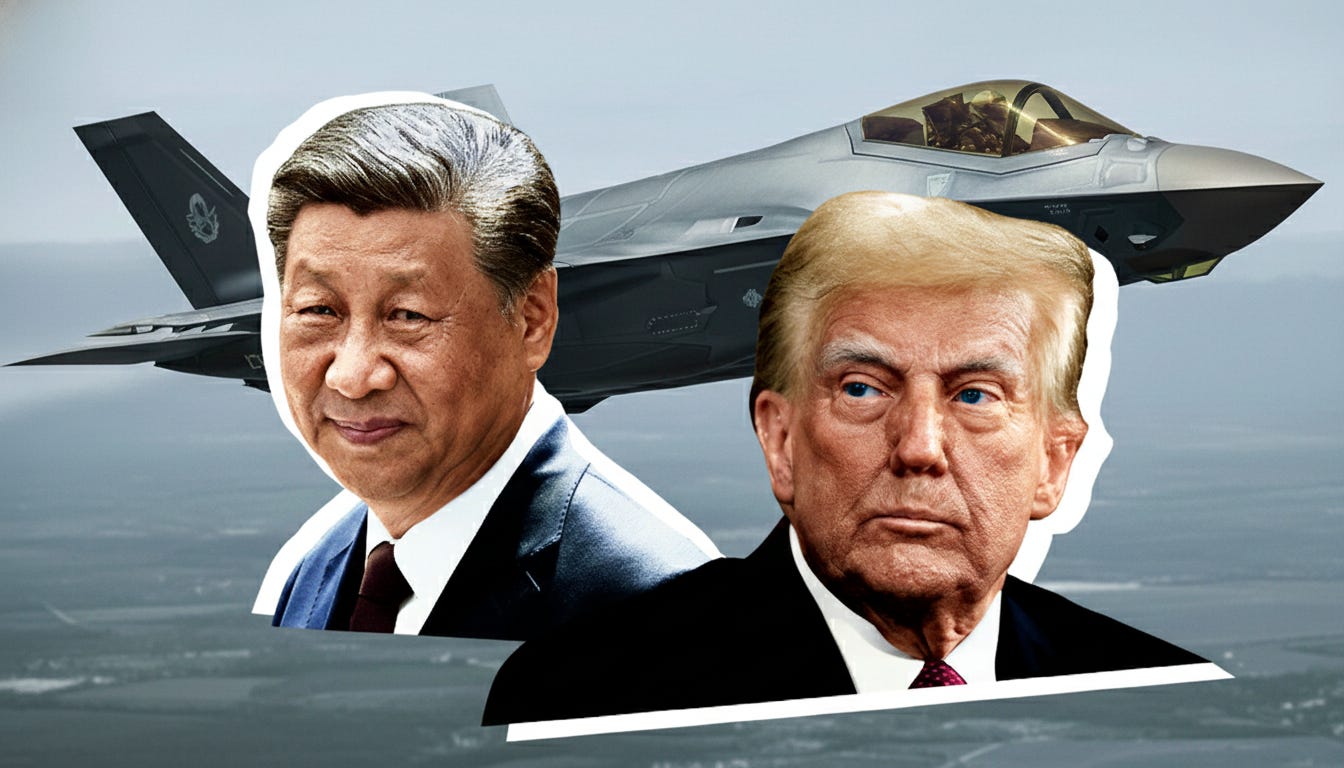
The most consequential geopolitical weapon of the next decade will not be a hypersonic missile, an artificial intelligence system, or a cyber capability.
It will be a licensing delay.
Somewhere in Beijing, inside the Ministry of Commerce headquarters on Chang’an Avenue, bureaucrats process export license applications for samarium, dysprosium, and terbium with the measured deliberation of customs officials who understand precisely what they are doing. They understand that the difference between a 7-day approval and a 45-day review represents the difference between industrial continuity and supply chain paralysis for the defense contractors building America’s military apparatus. They understand that a 120-day administrative hold, dressed in the language of regulatory compliance and technical review, achieves the same outcome as an embargo without the diplomatic cost of declaring one. They understand that the weapon they wield is invisible to the commodity analysts tracking spot prices in London and Shanghai, invisible to the defense equity analysts modeling backlog conversion in New York, invisible to the credit analysts running covenant tests on investment-grade spreads.
This is not speculation. This is the documented mechanism that reduced rare earth magnet exports to South Korea by 93% and to Japan by 91% between April and May of 2025 without a single formal embargo being declared. The Ministry of Commerce did not announce a ban. It did not issue a prohibition. It simply processed license applications with a deliberation that extended weeks into months, and the just-in-time manufacturing systems of two allied nations seized up from documentary friction before any price signal reached the trading floors.
The weapon is bureaucratic latency. It is already loaded. And on January 6, 2026, Beijing demonstrated to the world that it is willing to pull the trigger.
The thesis of this analysis is precise, testable, and carries implications for how trillions of dollars in strategic capital should be allocated over the next eleven months. China’s Ministry of Commerce has constructed a layered export control architecture across eight major regulatory announcements issued between April 2025 and January 2026. This architecture provides Beijing with surgical precision over rare earth flows to the global defense industrial base, the electric vehicle supply chain, the wind energy buildout, and every other industrial domain dependent on permanent magnets manufactured from neodymium, praseodymium, dysprosium, terbium, and samarium. The architecture includes extraterritorial jurisdiction assertions reaching into Japanese factories and German processing facilities, de minimis thresholds set at 0.1% that capture virtually every high-performance magnet on Earth, and technology transfer prohibitions that treat the tacit knowledge of Chinese separation engineers as a controlled munition.
The critical collision occurs in the fourth quarter of 2026. The suspension of China’s most aggressive export controls expires on November 10, 2026. The US-specific suspension expires on November 27, 2026. The Defense Federal Acquisition Regulation Supplement Clause 252.225-7052 Phase 2 takes effect on January 1, 2027, mandating that defense contractors certify their entire supply chains—from mine to magnet—contain zero materials that were mined, refined, separated, melted, or produced in China, Russia, North Korea, or Iran.
The arithmetic is clarifying. China currently controls 90% of global rare earth oxide separation. China controls 99% of heavy rare earth processing. China produces 100% of global samarium metal. The January 2027 DFARS deadline requires defense contractors to certify 0% Chinese content across the entire supply chain.
The regulatory collision creates a structural impossibility that consensus models tracking price and volume fundamentally cannot see. Commodity desks monitor spot prices. Defense analysts monitor backlogs. Credit analysts monitor spreads. No analyst team at any major institution monitors the intersection of Chinese administrative law, Japanese intermediate processing, American defense compliance requirements, and the network transmission dynamics that connect a licensing delay in Beijing to an F-35 delivery suspension in Fort Worth.
The weapon operates through administrative licensing latency. The target is compliance itself.
This is not a commodity analysis. This is a mechanism map of how regulatory procedure converts diplomatic incidents into defense industrial paralysis within six to twelve months of triggering. The January 2026 ban on dual-use exports to Japan over Prime Minister Sanae Takaichi’s Taiwan remarks provides the operational proof of concept. The question is no longer whether China can weaponize its supply chain dominance. Beijing answered that question on January 6, 2026. The question now is how China will calibrate the activation of controls during the critical September through November 2026 renewal window, and which institutions holding trillions in strategic assets have positioned for a contingency that the market still prices as a distant hypothetical rather than an approaching regulatory wall.
The wall is not distant. It is dated. It arrives on January 1, 2027.
What follows is the complete institutional playbook: the full regulatory mechanism documented announcement by announcement, the processing monopoly that mining cannot circumvent, the Japanese transmission channel that connects Chinese supply disruption to American weapons platforms, the Western diversification efforts that arrive a decade too late, the price signals hiding in plain sight, the 90-day positioning window that opens in September 2026, the adversarial gauntlet that the thesis survives, and the specific trade architecture for capturing the compliance scarcity premium before the market recognizes it exists.
The positions are already being built.
I. THE ARCHITECTURE OF ADMINISTRATIVE WARFARE
How Beijing Constructed a Regulatory Kill Switch That Commodity Models Cannot See
The contemporary weaponization of critical minerals by the People’s Republic of China represents an evolution in economic statecraft that the financial community has fundamentally mischaracterized. This mischaracterization is not a minor analytical error. It is a categorical mistake that has left institutional capital positioned for a world that no longer exists.
