The Reckoning
What the Strait Took Beneath the Oil, and the Clock the Market Stopped Watching

By Shanaka Anslem Perera | 9th July 2026.
There is a number that tells the world the food crisis is over.
It is not lying. It is late.
On 3 July 2026, the Food and Agriculture Organization reported that its global food price index averaged 130.3 points in June, down again from May, the second consecutive monthly decline, and 18.7 percent below the peak reached in March 2022. Wheat fell 4.4 percent. Maize fell 6.2 percent. To a screen trained on fifteen years of mostly frictionless logistics, this reads as an all-clear. The ceasefire was priced. The panic was over. The index said so.
The index is measuring the wrong thing, at the wrong point in the chain, on the wrong clock.
It is pricing grain that already exists, grown largely from fertilizer applied before the late-February rupture in the Strait of Hormuz impaired the clearance of the chemicals that make next season’s food. It is a photograph of the past being read as a forecast. What it does not capture is the distance between nutrients that exist on paper and nutrients that actually clear through a contested strait, a behavior-changing war-risk premium, a phosphate plant short one reagent, a treasury that cannot sustain the subsidy, and a farmer who has already decided not to buy.
That distance is where the next crisis is forming. It is measurable. It is widening in specific places. And it resolves not on the day the shooting stops but on the day the crop clock closes, which for the most exposed importers falls between now and the first quarter of 2027.
The claim here is narrow, falsifiable, and deliberately not apocalyptic. It is not that a universal food catastrophe is coming. The most likely outcome, on the evidence, is jagged normalization: cargoes clear unevenly, prices grind lower with volatility, and the aggregate index stays contained. That is the honest base case, and everything that follows is built on it, not against it.
The sharper point sits underneath the average.
Beneath a calm mean, a set of upstream and fiscal stresses remain live and imperfectly priced by the financial market. They are concentrated in the credit and currencies of a specific ring of import-dependent states, and in the chemical channel that runs from sulfur to phosphate. The cleanest expression is not the fertilizer-equity trade the crowd already ran and abandoned. The proof is already on the tape. In Pakistan, demand for diammonium phosphate, a key phosphate fertilizer, fell to 61,000 tonnes in May against a five-year average of 94,000, and inventories improved anyway, because farmers priced out of the warehouse do not register as scarcity. They register as quiet.
That quiet is the most dangerous data in the market.
What actually sits underneath it is a single molecule that ties the world’s food to the energy transition, a fiscal transmission that moves before any food price does, a contradiction at the center of Western policy, a weather event the market is reading backward, and a maritime insurance machine that proved money alone cannot move a ship through a killing zone.
That gap is the map.
The Wrong Unit
Every commodity has two supplies, and only one of them feeds anyone.
The first is nominal supply, the tonnage that exists somewhere in the world: in a warehouse in the Gulf, on a vessel at anchor, in a mine yet to be leached. The second is clearing supply, the tonnage that actually arrives where a plant can process it, a distributor can finance it, a port can unload it, and a farmer can apply it inside the narrow biological window when a crop can still use it.
In a frictionless system, the two are nearly identical, and the entire discipline of commodity forecasting is built on treating them as one. A tonne is a tonne. What exists will clear.
That assumption is what broke in 2026.
The distance between nominal supply and clearing supply, normally a rounding error, opened into the defining variable of the year. A cargo that exists but cannot obtain commercially viable war-risk cover is not usable supply. A cargo that clears the strait but arrives after the planting window has shut is not usable supply. Phosphate rock in the ground that cannot be turned into fertilizer because one upstream reagent has vanished is not usable supply.
The market kept counting the rock, the cargo, and the anchored vessel, added them up, and reported abundance. The soil counted only what arrived in time, and reported a deficit that will not surface in a food price index until the harvest it damaged comes due.
The missing variable deserves a name, because it will outlast this crisis.
Call it clearing power: the capacity of a country or a crop system to convert molecules that exist into food that grows before the window closes. Clearing power is not measured by how much fertilizer exists. It is measured by how much of it survives the gauntlet from export license to shipping to insurance to foreign exchange to subsidy to port to farmer to soil, on time.
Measure the world this way rather than by nominal tonnage, and the calm index dissolves into a very different map, one where the stress is not spread evenly but concentrated with surgical precision in the places least able to absorb it.
That map is the rest of the argument.
The Strait Beneath the Oil
Almost everyone watched the oil.
The oil was the misdirection.
When the Strait of Hormuz became commercially impaired at the end of February 2026 following military exchanges in the Gulf, the coverage fixated, as it always does, on hydrocarbons. Roughly a fifth of the world’s oil and a comparable share of its liquefied natural gas move through that twenty-one-mile-wide passage, and crude is the reflex the market reaches for first.
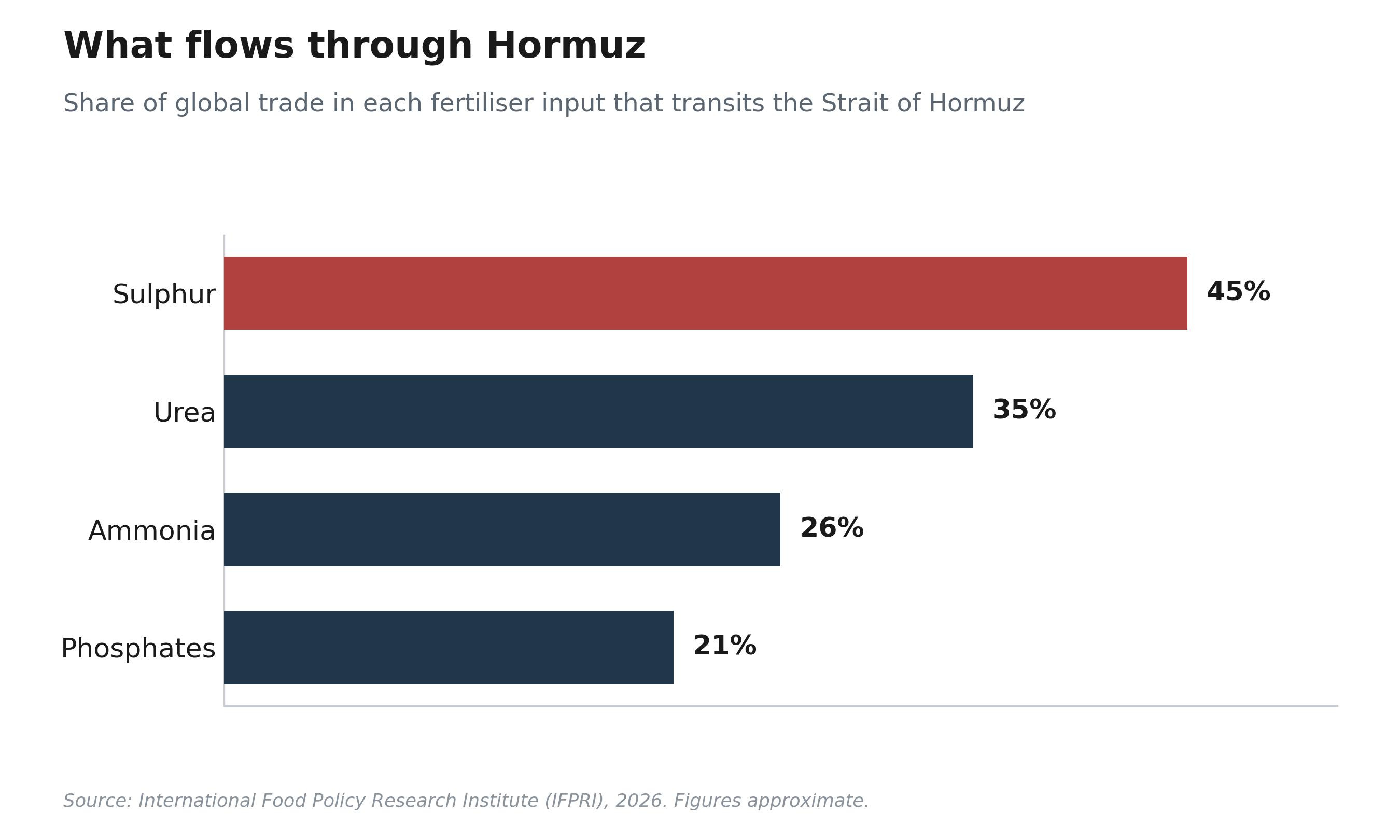
But the more consequential cargo in the hold was not energy. It was the chemical basis of the world’s food supply, and the Gulf is its single most concentrated corridor.
According to the International Food Policy Research Institute, the strait carries roughly 35 percent of global urea flows, more than a quarter of the world’s ammonia, just above 20 percent of its phosphates, and close to 45 percent of global sulfur exports. Its effective closure did not simply raise freight costs. It blocked an estimated 21 million tonnes of annual Gulf urea export capacity and roughly 4 million tonnes of diammonium phosphate export capacity from a global market with little short-run slack.
