The Reload War
How Firepower Became a Permissioned Asset

Shanaka Anslem Perera | July 7, 2026
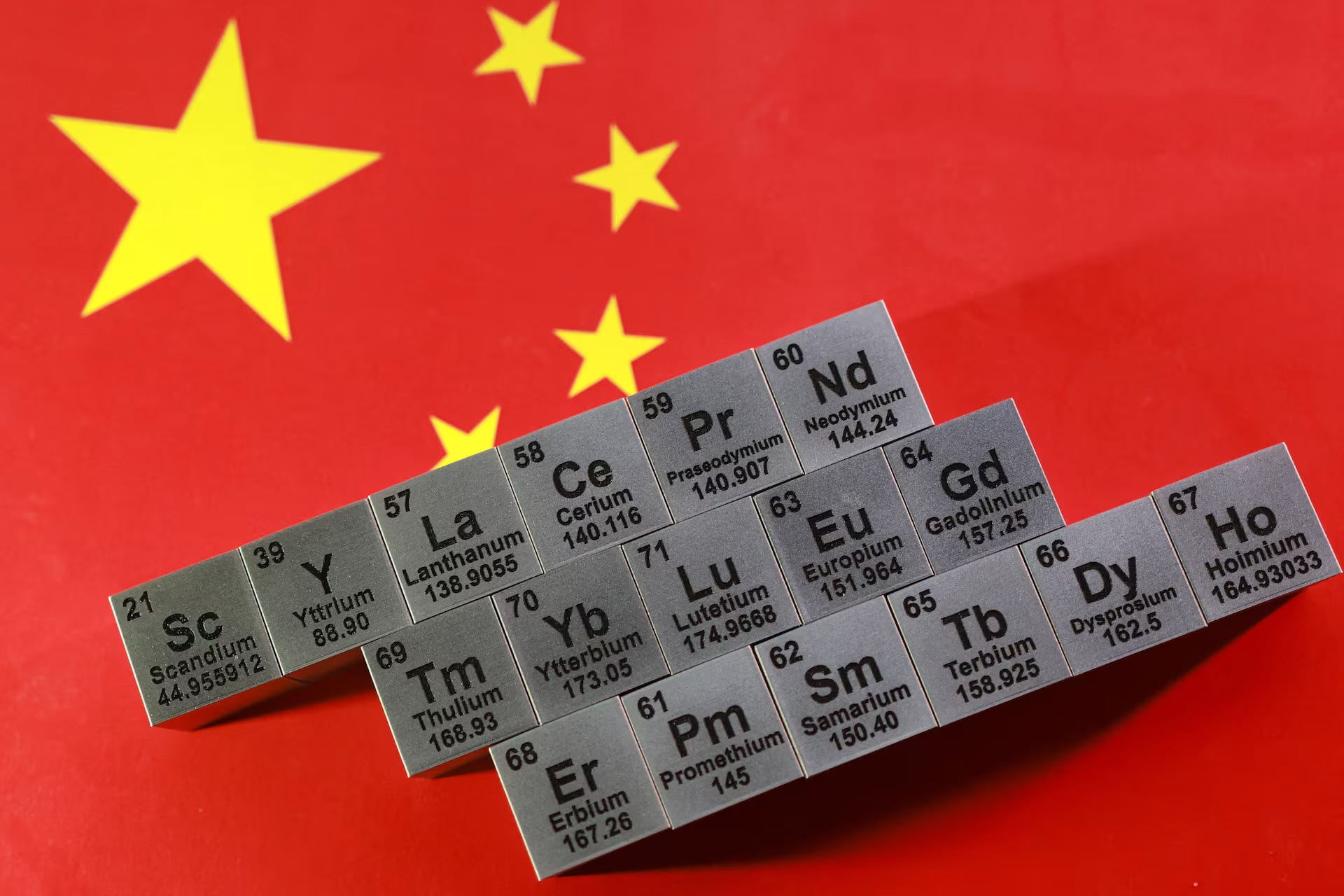
The Arsenal Is No Longer a Stockpile
Somewhere in your portfolio there is a line item that quietly assumes the United States can reload its arsenal. That assumption now runs through a chemical plant on the French Atlantic coast, a licensing office in Beijing, and a paragraph of American procurement law that activates on January 1, 2027.
The claim, in one breath. The 39-day war with Iran drew down between one quarter and four fifths of seven critical American munition inventories. The contracts and supplemental requests arrived within months. The missiles will not. Budget documents place the first deliveries from the FY2027 replenishment requests in mid-2029 for THAAD, May 2029 for Patriot, and March 2030 for Tomahawk. Between now and then, the covered magnets inside those weapons must clear two legal regimes closing from opposite directions: Beijing’s export permission architecture, whose key suspension expires November 10, 2026, and Washington’s own provenance law, which hardens on January 1, 2027 and demands a clean supply chain that does not yet exist at proven scale. For the next three years, deterrence is not a stockpile. It is a calendar.
One proof point, before anything else. In 2022 the Pentagon stopped accepting delivery of the F-35, America’s most expensive weapons program, because a single magnet inside one engine component was found to contain an alloy of Chinese origin. Deliveries resumed only after a national security waiver was signed. One alloy. One part. One halt. That was a rehearsal.
What follows traces the machine end to end: the expenditure ledger of the war, the factory floor beneath the contracts, the chemistry beneath the factories, the two sovereign audits closing on one supply chain, and the four gates behind the covered magnets inside the arsenal. It gives the strongest case against all of it at full strength, because an argument that cannot survive its own opposition is decoration. And it ends with dates, thresholds, and public records that will grade this reading in front of everyone, beginning September 20, 2026. The capital that reads the waiver ledger first will have the better map.
The Contract and the Calendar
On June 24, 2026, two documents left Washington within hours of each other, and the space between them is where this entire story lives.
The first was a contract record: Lockheed Martin, sole source, 35,327,237,604 dollars for THAAD interceptors, one of the largest missile procurement awards in modern American defense history, with performance running to June 2032. Of that sum, 842,871,672 dollars was obligated at award. The second was a letter from the White House budget office asking Congress for 87.6 billion dollars in emergency supplemental funding for the war, 67.15 billion of it for military operations and, per Breaking Defense, 21 billion to recoup munitions and shore up the industrial base, because, as the Center for Strategic and International Studies documented the week before, neither the FY2026 budget nor the FY2027 request had included war costs at all. The Secretary of Defense had earlier floated a total envelope approaching 200 billion dollars. The FY2027 defense request itself has been characterized at 1.5 trillion dollars, with appropriators already complaining that missiles funded through the reconciliation vehicle arrive with no delivery schedules attached in the justification books, which means part of the rearmament is, on paper, a promise with no date.
Read the two June documents closely together and the illusion dissolves quickly. A contract is a promise. A delivered interceptor is a cleared fact. The FY2027 request seeks 857 THAAD interceptors against a production history that, by CSIS’s reconstruction of budget exhibits, averaged 28 delivered per year over the past five years. Deliveries from that request begin in mid-2029. The 3,203 Patriot interceptors requested begin arriving in May 2029, from lines currently producing around 650 per year with roughly half committed to 18 other partner nations. The 785 Tomahawks requested begin arriving in March 2030, from a program that averaged 86 missiles per year over the past decade and has recently run below 200.
The Pentagon has already re-sequenced what exists. Updated FY2027 schedules show earlier THAAD orders redirected to American inventory ahead of allied customers, with missiles bought in FY2025 now delivering through 2026. Japan’s 400 Tomahawks have reportedly been delayed. Saudi Arabia waits on a 360 interceptor order from 2017, the Emirates on 96 from 2022. Ukraine’s access now runs through a mechanism in which allies pay for weapons drawn from American stocks, and President Zelensky has stated the arithmetic no communique will: every Patriot fired in the Middle East is one fewer available for Ukraine.
The money is definitely real. The orders are real. The re-sequencing is real. None of it changes the sentence that governs everything else in this piece: the market prices the contract, while the adversary prices the clearance chain.
The French Bridge
In the spring of 2025, according to reporting first published in the Seattle Times, procurement specialists across the American defense supply chain began making urgent phone calls about a metal most of them had never had to think about. Samarium. Beijing had placed it under export licensing on April 4, 2025, alongside six other rare earths, and within weeks the material that steers America’s most advanced weapons had become, in the words of that reporting, virtually unobtainable. The shortage was serious enough that the defense supply chain went looking for a Western samarium bridge almost immediately.
What it found was not a mine, not a breakthrough, not an act of Congress. It was an inventory discovery at a Solvay chemical facility in La Rochelle, France: a stock of samarium compounds accumulated over decades, sitting in a plant that has separated rare earths since 1948. American suppliers bought it. The material was converted to metal in the United Kingdom and shipped onward into the American magnet chain. By this month, the chief executive of Permag, parent of the only samarium cobalt magnet producer in the United States, was telling National Defense Magazine that the French stockpile had entered the supply chain and that the first magnets made from it were being produced, in his words, as we speak. Public characterizations of how long that stockpile lasts range from roughly two to three years in the most recent reporting to a three to five year foundation in the companies’ own announcements. Nobody outside the chain has published the true number.
