The Verification Collapse
The Next World Order Will Be Written by Whoever Controls Verification After Cheap Production Breaks Sovereignty


Drone war, stablecoins, AI, rare earths, and the 2027 cliffs are not separate stories. They are the first visible surfaces of a sovereignty stack being rebuilt around verification, autonomy, components, and protocol control.
By Shanaka Anslem Perera and Veron Ken Wickramasinghe
11th May 2026
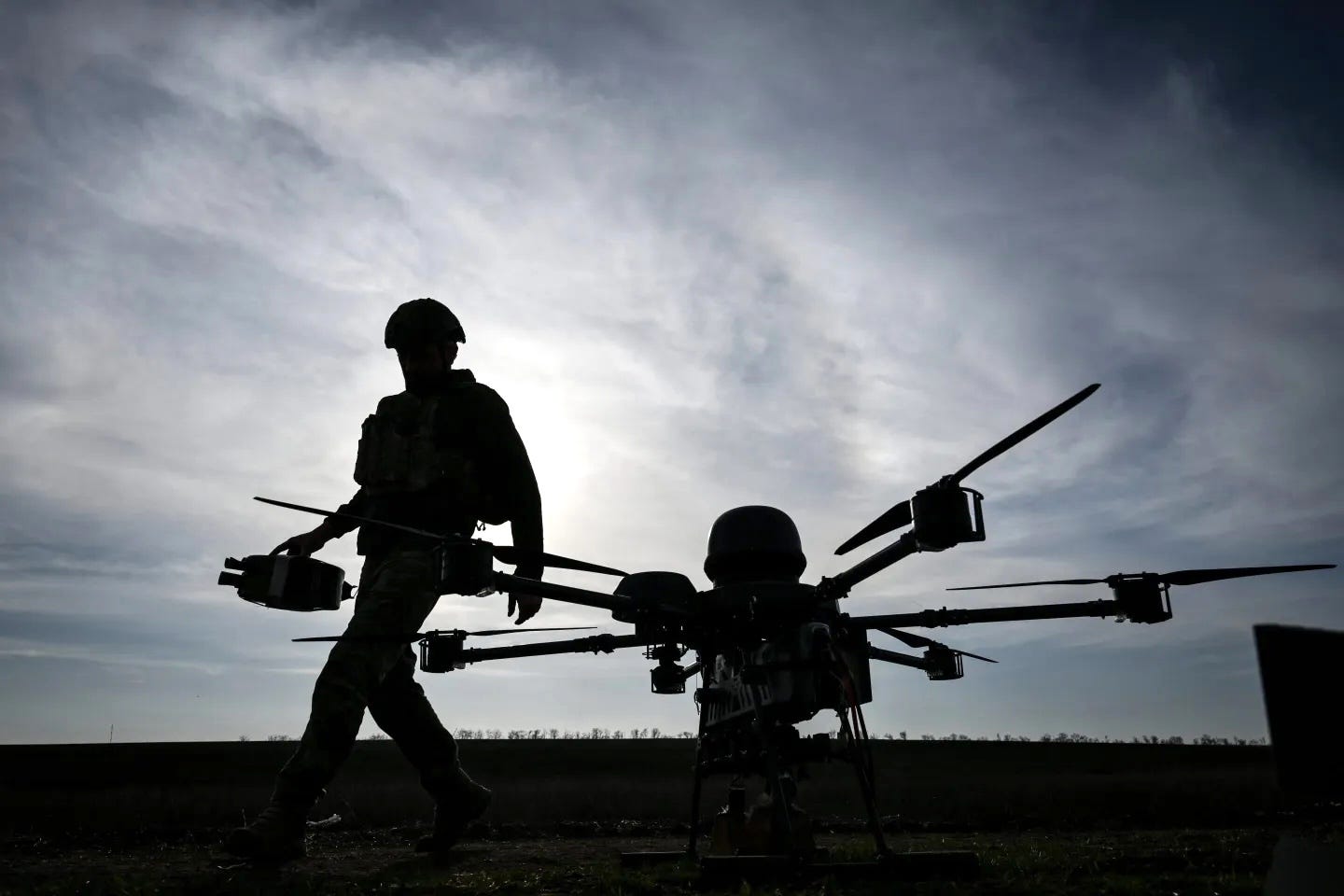
The drone war is not the revolution. It is the visible edge of one.
Across war, money, identity, compute, information, components, energy, and protocol governance, the cost of producing consequential outputs has fallen faster than the cost of verifying them. A drone strike is cheap. A synthetic voice is cheap. A stablecoin transfer is cheap. A model-generated report is cheap. What remains expensive is trusted confirmation: who fired, who settled, who spoke, who computed, who supplied, who governs, and who can still enforce the answer.
Ukraine is the battlefield case. Stablecoins are the monetary case. Deepfakes are the identity case. Rare earths, batteries, and semiconductors are the component case. The common variable is not cheapness. It is verification control after cheapness destroys the old monopoly.
That is the regime thesis under test. The next eighteen months decide whether it is only an elegant frame or the first map of the post-2030 sovereignty stack.
I. The Eight Surfaces
The asymmetry between cheap production and scarce verification expresses across eight domains, on the same timeline, with shared regulatory expressions in 2026 and 2027.
In the kinetic domain, drone strike and interceptor production are cheap. Kill confirmation, command and control, and operator competence are scarce. Ukrainian reported interception-or-jamming effectiveness climbed from 80.2 percent in December 2025 to 89.9 percent in March 2026 against Shahed-type launches that reached 6,583 in April per the Institute for Science and International Security. Confidence is high.
In the monetary domain, stablecoin issuance is cheap. Reserve attestation and the regulatory perimeter that defines whose dollar liability counts as compliant are scarce. The GENIUS Act, signed July 18 2025, established the federal framework for bringing private dollar-denominated settlement liabilities inside a reserve, disclosure, licensing, and supervisory perimeter, with implementation tied to the Act’s effective-date and rulemaking schedule. Tether’s exposure to United States Treasuries exceeded $127 billion as of June 30 2025 per its Q2 attestation. Federal Reserve Governor Stephen Miran confirmed in November 2025 that stablecoins are contributing to dollar dominance. Confidence is high.
In the identity domain, deepfake voice and video are cheap. Liveness, provenance, and multi-factor confirmation are scarce. Arup lost approximately $25 million in January 2024 to AI-generated executives in a Hong Kong video conference. JINKUSU CAM, described by Biometric Update citing VECERT Analyzer, is the live deepfake instrument now targeting remote identity verification and liveness checks. Confidence is medium.
In the informational domain, AI-generated content is cheap. Provenance, factual accuracy, and model evaluation are scarce. Anthropic’s submission to the Office of Science and Technology Policy states that powerful AI systems could emerge in late 2026 or early 2027. Confidence is medium.
In the compute domain, edge inference is cheap. Chip provenance and the export-control perimeter are scarce. The Federal Acquisition Regulation Council’s proposed rule implementing FY23 NDAA Section 5949 would prohibit executive agencies from procuring covered semiconductor products traceable to SMIC, CXMT, YMTC, or their affiliates from December 23 2027. Confidence is high.
In the components domain, assembly is cheap. Country-of-origin assurance and capacity outside China are scarce. The International Energy Agency placed China at 91 percent of global refined output of magnet rare earths and 94 percent of sintered permanent magnet production in 2024. Confidence is high.
In the energy domain, distributed solar and battery storage are cheap. Battery provenance and storage-stack control are scarce. Section 154 of the FY24 National Defense Authorization Act bars the Department of Defense from procuring batteries produced by CATL, BYD, Envision Energy, EVE Energy, Gotion High Tech, and Hithium Energy Storage Technology from October 1 2027, subject to waiver language. Confidence is medium-high.
In the protocol domain, networked devices and payment rails are cheap. The regulatory perimeter through which trust flows is scarce. The Federal Communications Commission added all foreign-produced uncrewed aircraft systems and critical components to the Covered List on December 22 2025 under FY25 NDAA Section 1709. Section 1260H direct procurement prohibition takes effect June 30 2026; the indirect prohibition takes effect June 30 2027, subject to a meaningful component exception. Confidence is high.
The eight domains do not share an identical bill of materials. They share something narrower: trusted compute, auditable hardware provenance, resilient power, secure networking, and component supply that can survive geopolitical enforcement. Drones and autonomous vessels express the battery, magnet, motor, and controller problem. Stablecoins and AI inference express the compute, energy, and attestation problem. Identity systems express the sensor, liveness, and provenance problem. The coupling is not identical hardware. It is shared dependence on verifiable substrate control.
Section 5949 and Section 1260H bind federal and defense procurement directly. They do not regulate every private instance of AI, stablecoin, or biometric infrastructure. Their broader significance is the trusted-hardware template that migrates outward through primes, regulated financial institutions, critical-infrastructure operators, and allied procurement rules. The legislative cluster recognizes the dependency overlap.
II. Ukraine: The Defender Becomes Cheaper for the Shahed-Class Threat
In December 2025, Ukrainian reported interception-or-jamming effectiveness stood at 80.2 percent against mixed inbound aerial threats. In January 2026, 82.5 percent. In February, 85.6 percent. In March, 89.9 percent. The denominator combines Shahed-type drones with cruise and a smaller proportion of ballistic missiles; the drone-only rate inside the headline figure is higher, the ballistic rate lower. Ukrainian Ministry of Defence reporting through Mykhailo Fedorov combines confirmed shoot-downs with electronic-warfare suppression, and that mixed denominator has been cross-checked against Defense News, the Institute for Science and International Security, Reuters, and CEPA.
The Institute for Science and International Security reported 6,583 Shahed-type uncrewed aerial vehicles launched in April 2026, including 4,335 Shahed-Geran strike variants assessed as produced at Alabuga, with multiple individual nights above 600 launches. The March 2026 volume sat at 6,463 by the same source. This is not a one-night anomaly. It is the emerging monthly baseline unless May and June data break the pattern.
Unit costs are documented at manufacturer-disclosure level. SkyFall’s P1-SUN prices to the Ukrainian military at approximately $1,000 per Reuters. General Cherry’s Sting sits at approximately $2,100. The Octopus 100 at approximately $2,300. The Merops at $15,000, with a stated production target of $10,000 at scale, and a Lithuanian sole-source procurement on April 22 2026 of 48 units at $15,000 each.
On the attacker side, the Russian Geran-2 production cost band sits between $35,000 and $80,000 per unit. The Institute for Science and International Security via CNN provides the lower bound; CSIS analysis and other open-source estimates place Shahed-type costs in the broad $20,000 to $50,000 range, while Alabuga-specific and hardened-variant estimates vary by configuration; the upper bound reflects jet-powered Geran-3 and electronic-warfare-hardened variants. Monthly Geran production reached approximately 3,000 units by late 2025 per the Institute for the Study of War and Ukrainian intelligence.
The unit-cost asymmetry, on the conservative reading, runs between 17 to 1 and 35 to 1 in favor of the defender for the Shahed-class threat at sustainable production volumes. This is not a marginal shift. It is a structural inversion of the historical air-defense cost geometry, in which the defender has always paid more per engagement than the attacker.
A caveat. Ukrainian Air Force Colonel Pavlo Yelizarov, in an interview carried by Ukrainian Pravda, stated that 170 of more than 300 interceptor crews had not downed a Shahed in a year. Subsequent Ukrainian Air Force commentary clarified that many of those crews were newly formed, with 66 crews accounting for the majority of confirmed kills. The bottleneck is the operator pipeline, not the platform economics.
The doctrine-export evidence is now clean. Reuters has reported that the United States military deployed Ukraine’s Sky Map command-and-control platform to Prince Sultan Air Base in Saudi Arabia, with Ukrainian personnel travelling to the base to train American forces. Empires export doctrine. They do not import it from non-NATO middle powers engaged in their own active conflicts. The Prince Sultan deployment is the clearest single piece of public evidence that the kinetic doctrine flow has reversed.
LUCAS makes the platform case. Reuters reported that the Low-Cost Uncrewed Combat Attack System was developed by Arizona-based SpektreWorks at approximately $35,000 per unit; Defense News reported first combat use on February 28 2026 and the $35,000 price. The system was deployed under Task Force Scorpion Strike. Whether LUCAS is structurally derivative of the captured Shahed-136 airframe is an interpretation; the unit cost and combat-use date are documented.
Operation Epic Fury converted the cost-exchange problem from a journal-article concern into a procurement-cycle binding constraint. Payne Institute estimates cited by Small Wars Journal place the first 16 days at 402 Patriot interceptors and 198 Terminal High Altitude Area Defense interceptors fired, a combined 600 units. Defense News reported that Pentagon officials briefed senators on a first-six-day cost of approximately $11.3 billion overall, not specifically for interceptor materiel. Navy Times reported 13 United States service members killed in action and 381 wounded across the operation through April 8 2026, with Sergeant Benjamin Pennington dying from injuries sustained at Prince Sultan Air Base. Interceptor counts, operation cost, and casualty totals address different questions and remain separate categories.
The Ukrainian Unmanned Systems Forces kill economics provide the most aggressive single data point. The Economist, in coverage carried by Ukrainian Pravda on March 24 2026, reported that Unmanned Systems Forces commander Robert Brovdi cited a cost of materiel of $878 per Russian soldier eliminated at a 400-to-1 exchange ratio. This is a combatant-reported figure, not an independently audited casualty statistic. Even taken with appropriate skepticism, it supports the directional shift.
What this means at the level the framework requires: at the unit-cost layer, the defender is now cheaper than the attacker for the dominant Shahed-class threat at sustainable production volumes by a factor between 17 and 35 to one. The all-in defended-outcome cost remains the falsification test. Reported interception-or-jamming effectiveness sits near 90 percent against a record launch volume. The Pentagon has imported command-and-control infrastructure from Ukraine. The Pentagon has fielded a domestically produced low-cost attritable strike system at approximately the same unit-cost band as the adversary’s drone.
The procurement bazaar is now real and trans-Atlantic. Defense News has documented active Ukrainian export negotiations with Denmark, Lithuania, Poland, and Germany across the Sting, Octopus, Merops, and P1-SUN production lines. The Driscoll Merops procurement of 13,000 units in eight days, reported by The War Zone in early 2026, illustrates the procurement tempo. Ukrainian manufacturers SkyFall, Wild Hornets, and General Cherry have shifted from defending the Ukrainian air-defense perimeter alone to supplying allied procurement at scale, with the structural implication that the unit-cost economics now travel. The interceptor production geography has moved from artisanal workshops in 2023 to factory-floor manufacturing in 2026 across multiple Ukrainian cities and adjacent NATO production hubs.
The command-and-control substrate has matured in parallel. Ukraine has launched Mission Control as a national digital system for managing drone operations inside the DELTA military ecosystem, while Brave1 Dataroom, built with Palantir support, provides secure visual and thermal battlefield datasets for training and testing military AI models against aerial targets including Shahed-type drones. The verification layer between sensor detection and kinetic effect is therefore real and operational. The Russian fibre-optic adaptation is partly a response to the success of this stack at radio-frequency dominance. The contest has migrated from the radio spectrum to the optical and acoustic spectrum on both sides.
III. The Attacker Adapts
The Russian adaptation is real and accelerating. Three thousand monthly Geran-class units by late 2025. Jet-powered Geran-3 variants now running approximately 15 to 20 percent of monthly launches at speeds approaching 400 kilometers per hour, compressing the intercept window relative to subsonic Shahed-class targets. The Geran-5 jet variant unveiled in January 2026. Electronic-warfare-hardened variants with frequency-hopping satellite navigation and inertial backup pushing the unit cost band toward the $80,000 ceiling.
The fibre-optic first-person-view drone is the most consequential adaptation. Cable spools above 60 kilometers make the platform effectively immune to electronic-warfare jamming. The drone-on-drone war shifts from a radio-frequency contest to a kinetic-and-optical contest, which the Russian Rubicon Center, established by the Russian Ministry of Defence in 2024, has been doctrinally maturing through 2025 and 2026.
The Rubicon framework integrates electronic warfare, kinetic counter-uncrewed-aerial-systems, and small-arms-equipped helicopter teams hunting Ukrainian interceptor crews. The 50th Varyag Brigade and the broader Russian Unmanned Systems Force, reported at approximately 101,000 personnel by Ukrainian Commander-in-Chief Syrskyi in April 2026, represent institutionalization at scale comparable to Ukraine’s.
The component-substitution dimension is the strategic core. The Russian Geran production line at Alabuga uses Nvidia Jetson onboard processors and Raspberry Pi 5 microcomputers, sourced through sanctions-evading networks the United States Treasury has been progressively dismantling but has not severed. Chinese co-production of fibre-optic FPV cable spools is the most direct documented component-supply linkage. The Russian fibre-optic platform is, in essential respects, a Chinese-Russian co-produced system reaching Russian production lines through opaque intermediaries.
None of this refutes the inversion. It establishes that the inversion is contested rather than absolute, that the attacker adapts at sustained operational tempo, and that the defender’s structural advantage in unit-cost economics is not a static condition. The defender must continue to scale production, expand the operator pipeline, and integrate directed-energy substitution at the pace at which the attacker upgrades platform sophistication.
The defender retains the unit-cost advantage at sustainable scale. The attacker retains the saturation-volume advantage at peak intensity. The integration race is the resolving variable. Treating the inversion as already resolved underestimates the Russian adaptation. Treating it as nullified by the Russian adaptation underestimates the structural cost asymmetry. Both observations belong in working memory at once.
A note on what the counter-case requires to actually win. Stephen Biddle and Richard Betts, in their March 27 2026 Foreign Affairs piece, advance the Sagger 2.0 framing: that the Shahed-and-interceptor complex is a single-system shock that combined-arms integration, electronic warfare, and dispersion doctrine will absorb on a timescale of weeks to months, not years. The Biddle frame has real force. Russian Geran-3 and Geran-5 jet variants are a partial absorption response. The Rubicon Center’s institutionalized counter-uncrewed-aerial-systems doctrine is another. Justin Bronk’s RUSI position, articulated most clearly in his August 4 2025 piece “NATO Should Not Replace Traditional Firepower with Drones,” argues that NATO is at risk of overlearning from Ukraine and that traditional artillery and air power remain the primary kinetic effectors against a peer adversary. Stacie Pettyjohn’s CNAS work, including “Evolution Not Revolution” and “Swarms over the Strait,” argues that drones in Ukraine represent evolutionary rather than revolutionary shift and that Indo-Pacific application is constrained by range and payload limits.
The counter-cases are not wrong. They are scoped too narrowly for the full substrate problem. The Sagger frame works where the substrate is purely doctrinal. It breaks where component sovereignty, monetary coupling, informational coupling, and protocol-sovereignty integration are simultaneously in play. The Bronk frame works against a strawman naive-substitution thesis. The integration thesis does not say drones replace traditional firepower. It says traditional firepower has been paralyzed by the battlefield-transparency regime that has elevated drones, and integration of cheap mass with cheap precision with cheap autonomy is the resolving variable. The Pettyjohn frame is correct about Indo-Pacific range constraints; the Indo-Pacific application requires a different platform class, not a different doctrine. The Bayraktar Kizilelma is the empirical demonstration that the Indo-Pacific platform class is being contracted now, with deliveries to Indonesia scheduled to begin in 2028.
IV. The Monetary Mirror
The GENIUS Act has been read narrowly: as payments-rail regulation, as consumer protection, as fintech infrastructure. The narrow reading misses the architecture.
The act, signed July 18 2025 with implementation tied to its effective-date and rulemaking schedule, represents the choice by United States Treasury, the Federal Reserve, and the Office of the Comptroller of the Currency to bring private dollar-denominated settlement liabilities inside a regulated reserve, disclosure, licensing, and supervisory perimeter rather than attempting to suppress them outside it. The state has not retreated from monetary sovereignty. It has expanded the regulated perimeter for private dollar-denominated settlement liabilities. This is the monetary mirror of the kinetic case in which the Pentagon has imported Ukrainian command-and-control infrastructure to defend American assets at Prince Sultan Air Base.
Tether’s Q2 2025 attestation reported total exposure to United States Treasuries exceeding $127 billion as of June 30 2025. Federal Reserve Governor Stephen Miran, in November 2025 public remarks, confirmed that stablecoins are contributing to dollar dominance and could affect loanable funds and monetary-policy transmission. TD Economics documented Tether Treasury holdings rising from approximately $81 billion to $105 billion between June 2024 and June 2025, and Circle from approximately $11 billion to $27 billion across the same window. The stablecoin sector has become a measurable source of new Treasury demand. The Apollo July 2025 analysis projects the broader stablecoin market at $2 trillion in market capitalization by 2028.
Tether’s USA₮, announced January 27 2026, is the institutional inflection. Issued through Anchorage Digital Bank under federal banking supervision, with Cantor Fitzgerald as reserve custodian and primary dealer, USA₮ creates a separate United States-regulated product line for Tether’s dollar-stablecoin ecosystem, while Tether’s global USD₮ continues to operate under a separate reserve, issuance, and regulatory structure. The structural parallel runs to 1933, when the United States regulatory architecture brought commercial banking inside a deposit-insurance perimeter rather than continuing to permit unregulated bank-note issuance. The mechanics differ. The institutional logic is recognizable.
The verification layer is what the perimeter regulates. BDO’s quarterly reserve attestations are the verification artifact. Anchorage’s Office of the Comptroller of the Currency charter is the verification artifact. The GENIUS Act’s monthly attestation requirement is the verification artifact. The actor that owns the verification layer for dollar-denominated settlement owns the monetary substrate of the post-Westphalian sovereignty stack. That actor is not exclusively the Federal Reserve. It is a regulated coalition of Office of the Comptroller of the Currency, Anchorage, BDO, Circle, Tether, and the broader licensed-issuer ecosystem. The Federal Reserve remains the lender of last resort to the banking system and the ultimate monetary-policy authority. It is not the direct backstop for every stablecoin issuer or token holder. The new architecture is a regulated perimeter around private dollar-denominated liabilities, not a transfer of sovereign money issuance.
The dollar’s reserve-currency function in the post-2030 order will depend on the verification credibility of the dollar-denominated stablecoin layer alongside Treasury debt issuance capacity. The People’s Bank of China has watched this play out and accelerated its central-bank-digital-currency timeline. The European Central Bank is doing the same with the digital euro. The contest is not whether stablecoins win. The contest is which jurisdiction’s stablecoin regime owns the verification layer. It runs on the same six-quarter clock as the 2026-to-2027 component-regulatory cluster in the kinetic domain.
The coalition that now holds the verification function does not look like the institutional architecture of any prior monetary regime. The Office of the Comptroller of the Currency holds the bank-charter authority. Anchorage Digital Bank holds the operational issuance license. BDO holds the attestation function. Cantor Fitzgerald holds the primary-dealer relationship. Tether and Circle hold the on-chain settlement infrastructure. The Federal Reserve retains its statutory authority as lender of last resort to the banking system and as the ultimate monetary-policy authority. The Treasury holds the residual debt-issuance function. Seven institutions, none of which alone constitutes monetary sovereignty, jointly constitute the regulated perimeter around private dollar-denominated settlement.
The institutional implication carries beyond the United States. In Europe, the comparable perimeter logic is the Markets in Crypto-Assets framework, under which issuers of asset-referenced tokens and e-money tokens require authorization and operate under European Banking Authority developed technical standards. Asset-referenced and e-money token provisions have applied since June 30 2024. The European framework differs from the GENIUS Act in design and supervisory architecture, but the direction is similar: private digital settlement instruments are being moved inside reserve, authorization, and supervisory perimeters. Singapore’s Monetary Authority has issued one of the most rigorous Asian regulatory frameworks for stablecoin issuers. The Hong Kong Stablecoin Ordinance, effective August 1 2025, brings Hong Kong inside a parallel perimeter aligned partially with mainland Chinese central-bank-digital-currency policy. The verification-perimeter logic is now the dominant pattern across regulated financial jurisdictions, not an American outlier.
The structural-substrate point is sharper still. The 1944 Bretton Woods architecture rested on gold convertibility plus the United States Treasury’s commitment to dollar-gold parity at $35 per ounce. The 1971 Nixon shock terminated that commitment and moved the dollar onto a floating regime backed by Treasury debt issuance and Federal Reserve policy alone. The 2025-2026 transition does not terminate the floating regime. It adds a verification layer beneath it, in which dollar-denominated settlement liabilities issued by regulated coalition partners function as a parallel rail with attestation-and-reserve mechanics that the Treasury and Federal Reserve do not themselves operate. This is not a third regime. It is the floating regime augmented by a verification substrate that did not exist in either 1944 or 1971.
V. Cognition, Identity, Components, Energy, Protocol
Generative AI has driven marginal inference cost toward marginal electricity cost. Anthropic’s submission to the Office of Science and Technology Policy states that powerful AI systems could emerge in late 2026 or early 2027. DeepMind chief executive Demis Hassabis has been more cautious, describing human-level AI as five to ten years away in Davos commentary and elsewhere assigning roughly 50 percent probability by 2030. Prediction markets remain skeptical of a formal OpenAI artificial-general-intelligence announcement before 2027, with the Polymarket contract trading in the low double digits through early May 2026. Ferrara’s 2026 four-layer trust-collapse framework formalizes what the cost curve has produced: production cheap, verification scarce.
The labor-market evidence has begun to accumulate. The Stanford Digital Economy Lab work by Erik Brynjolfsson and collaborators documented productivity multipliers of 14 to 15 percent for AI-assisted customer-support workers and 34 percent for novices in 2024 studies, with subsequent work suggesting compounding gains as task scope expands. The Anthropic Economic Index, the OpenAI usage data, and the McKinsey Global Institute forecasts each project labor-substitution effects across knowledge-work categories at scales that historical productivity transitions have not matched. The verification-cost framing absorbs this: the cost of producing a coherent published artifact has fallen toward the marginal cost of inference, and the institutional question is who or what verifies the artifact downstream. Attribution mechanisms, model evaluation, and synthetic-content provenance are the scarce-good layer.
Identity sits in the same geometry. The Arup engineering-firm fraud of January 2024 extracted approximately $25 million through AI-generated executives in a Hong Kong video conference. JINKUSU CAM, described by Biometric Update citing VECERT Analyzer, targets remote identity verification and liveness checks at financial-services platforms with twenty-to-thirty-second voice-clone impersonation capability. The TRM Labs analysis of the A7 network, a Russia-linked sanctions-evasion infrastructure with significant stablecoin-linked volume including the A7A5 stablecoin and A7 wallet clusters, documents the convergence of identity-spoofing and monetary-rail exploitation. Story Protocol and Numbers Protocol, per the Struck Capital analysis, represent the early cryptographic counter-stack. The Coalition for Content Provenance and Authenticity standard, backed by Adobe, Microsoft, the BBC, and others, has progressed from technical specification toward production deployment across major content-creation platforms. The cryptographic-provenance counter-stack is real, growing, and contested at the standards-body and platform-adoption layers.
The identity case also intersects directly with the kinetic and monetary cases. The same biometric-verification systems that financial-services platforms use to onboard customers also gate access to defense-procurement portals, classified-system credentials, and sovereign-identity infrastructure. A deepfake that defeats Coinbase’s onboarding flow can also defeat any verification system built on similar sensor-and-liveness mechanics. The convergence is not narrative. It is the architectural fact that identity verification across the eight surfaces uses overlapping technological substrates that fail or succeed together.
Components carry the deepest concentration risk. The International Energy Agency placed China at 91 percent of global refined output of magnet rare earths and 94 percent of sintered permanent magnet production in 2024. The agency also documented China at approximately 80 percent of global battery cell production, around 85 percent of manufacturing capacity, more than 90 percent of anode active material, and more than 98 percent of lithium-iron-phosphate cathode material and lithium-iron-phosphate cells. The supply-chain concentration has not materially shifted since.
Energy follows components. Section 154 of the FY24 National Defense Authorization Act prohibits Department of Defense procurement from CATL, BYD, Envision Energy, EVE Energy, Gotion High Tech, and Hithium Energy Storage Technology effective October 1 2027, subject to waiver language. Duke Energy’s February 2024 decommissioning of an 11-megawatt by 11-megawatt-hour CATL system at Camp Lejeune was the early commercial-sector pre-positioning indicator. Western battery-substitution capacity remains gradual and capital-intensive.
Protocol is now contested at the regulatory perimeter. The Federal Communications Commission’s December 22 2025 Covered List addition of all foreign-produced uncrewed aircraft systems and critical components, including DJI Technologies and Autel Robotics under FY25 NDAA Section 1709, was the first categorical country-of-production-based Covered List entry. DJI filed a reconsideration petition on January 21 2026; the public-comment deadline was set for May 11 2026. The Federal Communications Commission has subsequently allowed certain software and firmware updates for already-authorized foreign-made drones and routers to continue, on a phased basis, until 2029, a measure that does not remove the affected entities from the Covered List but signals the regulator’s intent to avoid creating cybersecurity risk through abrupt update freezes. The Department of Defense Blue UAS framework, referenced in current Federal Communications Commission guidance under the Department of Defense or Department of War naming convention, defines the positive trust perimeter on a parallel timeline.
Production has become cheap across all eight surfaces. Verification has become scarce. The state is now actively investing in the verification layer because the production layer can no longer be controlled through traditional regulatory means. Eight surface expressions. One underlying shift.
VI. The Substrate Reframing
The Westphalian sovereignty bundle, established in 1648 and progressively refined across three centuries, integrated four functions in a single state-centered package: territorial monopoly, monetary monopoly, informational monopoly through the educational and broadcast infrastructures, and security monopoly through the legitimate-violence claim. The bundle was a historical product of the production-cost economics of its era. Armies were expensive; only states could field them. Coinage was expensive; only states could underwrite it. Mass communication was expensive; only states could build broadcast infrastructure. Police forces were expensive; only states could maintain them.
The bundle is coming apart, not because states have weakened in absolute terms, but because the production-cost economics that justified the bundle have collapsed. Cheap drones produce kinetic effects that no state previously could afford in mass. Cheap stablecoins settle dollar-denominated transactions at scales the Federal Reserve never imagined when the bundle was structured. Cheap AI produces informational outputs at marginal cost no broadcast infrastructure could approach. Cheap cryptographic primitives verify identity at densities no state apparatus could supervise.
The post-Westphalian substrate stack, if it crystallizes, is likely to contain four substrate layers that map to the four legs of the original bundle. Verification replaces informational monopoly. Autonomy replaces security monopoly through machine-speed decision integration. Components replace the territorial-economic monopoly through global supply-chain control rather than territorial enclosure. Protocol is the genuinely new layer; protocols did not exist as a state-relevant category when the 1648 bundle was constructed.
The actor that integrates a stack across all four substrate layers first will write the operational rules of the post-2030 international order, in the structural sense in which the British-American partnership wrote the post-1945 order through Bretton Woods, the United Nations, the General Agreement on Tariffs and Trade, and the North Atlantic Treaty Organization. The 2026 to 2032 interval is when the integration race resolves. The United States and its closest allies hold the strongest position on verification, autonomy, and protocol. China holds the strongest position on components. The integration race is the race between American verification-and-autonomy-and-protocol primacy and Chinese components primacy, with the 2026-to-2027 regulatory cluster functioning as the American attempt to neutralize the Chinese components advantage before the integration window closes.
A hypothesis to be tested at the November 2026 inflection and the November 2027 gate. Not a settled proposition.
History offers five prior moments when the international order was reconfigured at the substrate level. The 1648 Peace of Westphalia integrated the four-function state bundle and codified non-interference. The 1815 Congress of Vienna stabilized a multipolar European concert and established the diplomatic-conference mechanism as a standing institution. The 1919 Versailles settlement attempted to extend Westphalian sovereignty to ethnic and national self-determination, with mixed results. The 1944 Bretton Woods conference plus the 1945 to 1949 institutional buildout (the United Nations, the General Agreement on Tariffs and Trade, the Marshall Plan, the North Atlantic Treaty Organization) constructed the integrated post-1945 order. The 1971 Nixon shock terminated dollar-gold convertibility and moved the dollar onto the floating-rate regime that has prevailed since.
Each of those transitions resolved across a window of three to seven years from the moment the underlying conditions made the prior regime untenable to the moment the new architecture stabilized. Each was driven by a recognition that the production-cost economics underneath the prior bundle had shifted, and that the institutional bundle had to be rewritten to accommodate the shift. The 1648 settlement followed the Thirty Years’ War and the realization that confessional religious authority could no longer underwrite political legitimacy at scale. The 1815 settlement followed the Napoleonic wars and the realization that a single hegemonic continental power was structurally unstable. The 1919 settlement followed industrial total war and the realization that the pre-1914 balance-of-power system could not contain industrial mobilization. The 1944 settlement followed two industrial wars and the realization that the gold standard could not coexist with welfare-state fiscal capacity. The 1971 settlement followed the structural imbalance of post-war reconstruction and the realization that fixed exchange rates could not survive divergent growth and inflation.
The 2026 transition, if the thesis holds, is the sixth instance and the first since 1971. It follows the production-cost collapse across the eight surfaces and the recognition, arriving in waves across United States executive-branch and legislative processes since 2022, that the verification monopoly underneath the post-1945 order has been progressively transferred or eroded. The hypothesis is that the eight-domain coupling is the empirical signature of a Westphalian-magnitude substrate reconfiguration, not merely a technological or sectoral shift. The 2026-to-2027 regulatory cluster is the American attempt to anchor the new architecture before the components-layer disadvantage compounds. The November 2026 and November 2027 gates are the testing window.
The hypothesis is bold. The historical comparison places it where it belongs: at the level of state-formation transitions, not at the level of policy adjustments. Whether 2026 to 2032 stabilizes a coherent post-Westphalian institutional bundle or fragments into competing regional substrate regimes is the question the eighteen-month window will begin to resolve.
VII. The 2026 to 2027 Cluster
The strongest evidence for coupling is the cluster of binding regulatory dates falling within a narrow window. The cluster is unlikely to be analytically coincidental. It is best read as a regulatory signature of the shift, subject to the falsification gates that follow.
June 30 2026. Section 1260H direct-procurement cutover under FY24 NDAA Section 805. The Department of Defense Chinese Military Companies List, updated to 134 entities on January 6 2025, prohibits direct contracts between the Department and listed entities from this date. The direct cutover affects relatively few American defense primes because most do not contract directly with listed Chinese entities. The bite arrives through Section 851 of the FY25 NDAA, which takes effect on the same date and prohibits Department of Defense contracts with companies that engage lobbyists for Chinese Military Companies List entities.
November 10 2026. The binding near-term inflection. China’s Ministry of Commerce, through MOFCOM Announcement 70 of 2025, suspended for one year the October 9 2025 export-control package covering rare earths, lithium batteries, graphite anodes, and related processing technologies. The suspension covers the 0.1 percent extraterritorial rule, the Foreign Direct Product Rule for rare-earth technologies, controls on five additional elements (holmium, erbium, thulium, europium, ytterbium), and licensing requirements for processing, refining, and magnet manufacturing technology. The April 2025 controls on samarium, gadolinium, terbium, dysprosium, lutetium, scandium, and yttrium remain in force throughout the suspension.
China retains a one-year option to reinstate the most aggressive export-control package any major economy has imposed on rare earths. The decision will be made by November 10 2026. It is bound up with the Trump-Xi trade trajectory, with Beijing’s internal calculations on whether to use the rare-earth instrument before Western diversification produces operational substitutes or to defer it, and with the supply-chain reconfiguration progress at Lynas, MP Materials, USA Rare Earth, and the Australian and Canadian processing initiatives.
Pentagon exposure is severe. Multiple American advanced weapon systems require rare-earth permanent magnets at critical points in their bills of materials. The Operation Epic Fury interceptor expenditure of 402 Patriots and 198 Terminal High Altitude Area Defense interceptors in the first 16 days has opened a replenishment requirement that the Lockheed Martin January 29 2026 framework agreement, which targets 400 Terminal High Altitude Area Defense units per year against historical production of approximately 96 per year, can satisfy only if the rare-earth supply chain remains open. The November 10 2026 decision therefore determines whether the Pentagon’s restocking cycle proceeds on the current timeline or is delayed materially, potentially by multiple quarters, depending on waiver use, stockpile drawdown, substitute magnet availability, and allied processing capacity. A single Chinese regulatory decision can extend the American magazine-depletion window, during which a second crisis on the same scale would face a materially reduced interceptor inventory.
Insurance markets have already priced the adjacent escalation risk. Lloyd’s of London war-risk premiums for Gulf-region shipping transit climbed materially during Operation Epic Fury, with US, UK, and Israeli-flag vessels charged at multiple times the baseline rate per Lloyd’s List. The Joint War Committee expanded the high-risk area on March 3 2026 to include waters around Bahrain, Kuwait, Oman, Qatar, and Djibouti. The signal is structurally similar to the credit-default-swap repricing of 2007: in both cases, insurance priced the structural risk before institutional research consensus caught up. These actions do not directly price rare-earth replenishment risk. What they confirm is that market plumbing reacts faster than policy language, and that financial transmission can lead ministerial recognition by quarters. Insurance-market repricing therefore functions as a leading indicator of where the framework will be tested next, even where the specific risk being priced sits adjacent to rather than identical to the substrate exposure.
The Hormuz dimension carries the deepest fiscal-attritional implication. Operation Epic Fury exposed a class of constraint the Pentagon had not previously had to face at this severity: the ability of an adversary armed with adequate component supply to drive American interceptor inventory consumption faster than American production can replenish it, while simultaneously imposing operational cost in dollars per day that compounds against the broader fiscal envelope. The Defense News reporting of the $11.3 billion first-six-day cost is one data point; the Pentagon’s roughly $200 billion supplemental request to the Office of Management and Budget for replenishment is the other. The American Enterprise Institute analysis of the $1.56 billion reprogramming across nearly 70 program lines, covering 85 PAC-3 MSE units, 1 SM-6, 23 SM-3 1B, and 15 THAAD, established the procurement-line specificity of the response.
The Pentagon’s response to Epic Fury is therefore the empirical test of whether the regulatory cluster is binding or merely procedural. If the November 10 2026 rare-earth decision reinstates the package, the THAAD replenishment cycle stalls at the magnet stage, and the Pentagon’s second-crisis preparedness collapses into a multi-quarter inventory hole, with the precise duration depending on waiver application, stockpile drawdown, and allied substitution progress. If the suspension extends and Western diversification continues at the current Lynas, MP Materials, and USA Rare Earth pace, the inventory hole narrows but does not close inside the eighteen-month window the framework specifies.
June 30 2027. Section 1260H indirect-procurement cutover. This is the legally complex cutover: Crowell and Moring analysis confirms that the goods-and-services prohibition contains a meaningful exception for components incorporated into higher-level end items. The cliff bites at the end-product level but permits component-level continuation through the indirect channel. The component exception was inserted in conference because the alternative was a categorical halt to American defense production that would have taken multiple major program lines offline within eighteen months. The cliff is sharper at the end-item layer than at the component layer.
October 1 2027. The CATL battery ban. The sharper of the two component-specific cliffs. Section 154 targets a named set of entities and a named component category with statutory clarity. Waiver language exists but is constrained. Commercial-sector pre-positioning is visible in the Duke Energy decommissioning pattern. The Pentagon’s drone-grade and energy-storage lithium-ion supply chain, currently concentrated in Chinese production, must reconfigure within this window or the Department’s autonomous-systems and energy-storage procurement scale becomes structurally constrained.
December 23 2027. The CXMT semiconductor cutover. The Federal Acquisition Regulation Council’s proposed rule implementing FY23 NDAA Section 5949 would prohibit executive-agency procurement of covered semiconductor products or services traceable to SMIC, CXMT, YMTC, or their affiliates. The proposed rule includes lifecycle exceptions for equipment acquired before the effective date and safe-harbor provisions that will shape operational severity. The cutover applies to federal executive-agency procurement, not to private commercial use of the covered products. It is sharpest for federal autonomy-stack compute procurement, where edge-compute autonomy depends on memory and logic at the legacy-and-mature-node scale where the listed Chinese producers are positioned.
Section 5949 and Section 1260H bind federal and defense procurement directly. They do not regulate every private instance of AI, stablecoin, or biometric infrastructure. Their broader strategic significance is that they establish a trusted-hardware template that migrates outward through primes, regulated financial institutions, critical-infrastructure operators, and allied procurement rules. The template-migration mechanism is the channel through which the federal procurement perimeter shapes the broader commercial substrate environment, not direct statutory reach.
Two component-specific cliffs cluster inside an eighty-four-day window in late 2027: the October 1 CATL battery restriction and the December 23 Section 5949 semiconductor cutover. A third procurement cliff, the Section 1260H indirect-procurement cutover, arrives earlier on June 30 2027 and is softened by the component exception. The rare-earth suspension expiry on November 10 2026 precedes the late-2027 component cliffs by roughly eleven months. The cluster is not a single ninety-day legal event. It is a staged enforcement sequence. Each date was set by an independent legislative or regulatory process across multiple years: FY23 NDAA Section 5949 in December 2022, FY24 NDAA Sections 154 and 805 in December 2023, FY25 NDAA Section 1709 in December 2024, MOFCOM Announcement 70 in October 2025, Federal Acquisition Regulation Council proposed rules through 2025 and 2026. The independent processes converge across a narrow eighteen-month interval, not inside a single quarter.
The sample size for testing whether this convergence is statistically significant is one, so standard hypothesis-testing does not apply. The question that does apply is whether the convergence is consistent with a shared upstream cause. The hypothesis is that it is. The shared cause is the recognition, arriving in waves across United States executive-branch and legislative processes since 2022, that the verification monopoly in advanced compute, advanced batteries, rare-earth permanent magnets, and drone-grade protocol substrates has been progressively transferred to Chinese industrial-policy positioning across the past three decades. The cluster reflects the moment that recognition crystallized into coordinated regulatory response. If China extends the rare-earth suspension and the three 2027 procurement events pass without material enforcement, the coupling claim weakens. If China reinstates and the three 2027 procurement events produce the expected supply-chain reconfiguration pressure, the coupling claim strengthens.
VIII. Where Capital Is Already Pricing the Shift
The cleanest empirical test of the coupling thesis at the capital-allocation layer is the divergence in valuation behavior between private autonomy-stack issuers and public legacy-adjacent defense names.
Anduril’s Series H has been in active marketing since at least February 14 2026, when Bloomberg reported the company in talks for a round of up to $8 billion at a post-money valuation of more than $60 billion, co-led by Thrive Capital and Andreessen Horowitz. Subsequent reporting in March 2026, including The Wall Street Journal on March 3 and Axios on March 4, confirmed the targeted valuation and reported round sizes between $4 billion and $8 billion. The most recent confirmed primary round prior was the June 2025 Series G at $30.5 billion per Tracxn. The round has not been formally announced as closed. Anduril revenue ran at approximately $2 billion in 2025 with projections in the $4 billion range for 2026, placing a potential closed round at roughly 30 times trailing or roughly 15 times projected revenue, depending on the base used.
Shield AI’s confirmed Series F-1 closed at $5.3 billion post-money in March 2025 per PR Newswire, with L3Harris and Hanwha leading the strategic component. Subsequent reporting indicates a follow-on round at approximately $12.7 billion post-money. Hivemind Enterprise is positioned as the autonomy-verification layer across multiple original-equipment-manufacturer relationships.
Saronic closed a Series D on March 31 2026 at $1.75 billion raised on a $9.25 billion valuation, led by Kleiner Perkins, per the company press release carried by CNBC and Defense One. The $392 million Navy contract for autonomous surface vessels, signed earlier in March 2026, anchors the production side. Port Alpha, the company’s next-generation shipyard, is the production-capacity bet.
Helsing reached approximately €12 billion post-money on the most recent disclosed round, with the Bundeswehr framework contract environment compressed from approximately €4.3 billion to €2 billion in February 2026 per Reuters reporting, following contested Helsing-STARK Virtus testing outcomes. Initial Bundeswehr contracts of approximately €536 million were approved alongside the framework reduction. Quantum Systems reached €3 billion-plus. German autonomy-stack capital formation runs at approximately one-fourth American capital formation on the same timeline.
The public-market expression diverges. AeroVironment NASDAQ AVAV is down approximately 57 percent from its 52-week high. The SCAR contract termination of $1.7 billion, a $151.3 million goodwill impairment, reduced FY26 revenue guidance to $1.85 billion to $1.95 billion, and the Raymond James triple-downgrade drove the compression. KeyBanc cut the price target from $330 to $295. The LOCUST counter-uncrewed-aerial-systems laser, tested aboard USS George H. W. Bush, represents the directed-energy adjacency that could re-rate the company if validated at scale.
Kratos NASDAQ KTOS is down approximately 55 percent from its 52-week high despite a Q1 2026 record backlog of $2.01 billion and an opportunity pipeline of $14.3 billion per the company’s investor-relations release of May 6 2026. FY26 revenue guidance was raised to $1.70 billion to $1.76 billion. The Valkyrie collaborative combat aircraft program and the hypersonic program of record, including the verbal award above $1 billion cited by chief executive Eric DeMarco on the Q1 2026 earnings call, are the operational catalysts. The Prometheus solid-rocket-motor joint venture extends exposure to the broader propulsion-supply substrate.
DroneShield ASX DRO posted Q1 2026 revenue of A$74.1 million, up 121 percent year on year, with A$155 million committed for 2026 and an A$2.2 billion pipeline. FY25 revenue at A$216 million was up 276 percent year on year. The 52-week share-price range of A$1.16 to A$6.71 reflects equity-market volatility around the chief executive transition in April 2026, not fundamental operating degradation.
Private capital appears to be pricing the next-generation autonomy stack at forward-revenue multiples that imply substantial execution risk and correct identification of the substrate. Public capital is penalizing legacy-adjacent names for revenue-cycle and execution-cycle issues that obscure the underlying substrate transition. The arbitrage between the two sits at the entry-point question rather than the directional question.
The framework-level trade thesis follows. The purpose is exposure mapping, not recommendation. Long autonomy-stack private exposure where accessible (Anduril, Shield AI, Saronic, Helsing, Quantum Systems through secondary-market vehicles) is the directional vehicle. Long non-Chinese critical-minerals exposure (heavy-rare-earth processing, sintered neodymium-iron-boron magnet capacity outside China) is the component-sovereignty hedge. Short or paired against the most legacy-adjacent public names at the unmanned-substitution boundary, with sizing discipline that protects against rate-cycle volatility. Directed-energy integrator exposure (Rafael, MBDA through parents, Leonardo, Rheinmetall, QinetiQ, AeroVironment selectively on LOCUST validation, Kratos selectively on counter-uncrewed-aerial-systems validation) is the integration-pillar position. Cross-pillar hedges in stablecoin infrastructure (Circle Internet Group post-2025 initial-public-offering, Anchorage-equivalent regulated-banking exposures), AI substrate (Anthropic, OpenAI, xAI secondary-market vehicles where accessible), Chinese rare-earth and battery exposure (CATL Hong Kong listing, the broader Chinese magnet ecosystem) as the bear-case hedge, sovereignty-credibility currency cross-rates (Australian dollar versus United States dollar, Israeli shekel versus euro, Turkish lira in size-limited form, Japanese yen versus Korean won, British pound versus euro), and insurance-market mispricing alpha (Lloyd’s syndicate exposure where accessible) extend the construction beyond the kinetic domain.
Detailed sizing belongs in a separate institutional memo. The directional framework is what the present piece carries.
A note on each named issuer, summary-level, holding the same architectural logic.
Anduril Industries has been positioned as the integrated kinetic-autonomy platform since 2017. Lattice, the company’s command-and-control and battle-management layer, functions as the verification substrate across autonomous sensors, autonomous strike vehicles, autonomous surface and subsurface platforms, and operator interfaces under a single sensor-fusion and target-prioritization architecture. Series G closed June 2025 at $30.5 billion post-money. The Series H has been in marketing since at least February 2026 with reported round sizes between $4 billion and $8 billion at a target valuation above $60 billion. If the round closes at those terms, Anduril would price at roughly 30 times reported 2025 revenue of approximately $2 billion, or roughly 15 times projected 2026 revenue near $4 billion, depending on which revenue base the allocator uses. That is not legacy-defense pricing. It is substrate-transition pricing with substantial execution risk. Arsenal-1 in Ohio is scheduled to begin production in July 2026. The YFQ-44A Fury collaborative combat aircraft program, if Anduril is selected for Increment 1 production, would establish the company as a prime contractor in a category previously dominated by legacy primes. The bull case rests on Lattice penetration across allied procurement, Arsenal-1 ramp on schedule, and Fury selection. The bear case rests on procurement delays, Lattice losing autonomy-substrate share to competing platforms, and the Series H closing below the targeted valuation.
Shield AI has been positioned as the autonomy-software-and-platform integrator. Hivemind Enterprise, the autonomy-decision verification layer across multiple original-equipment-manufacturer relationships including L3Harris and Hanwha, is the analytical center of gravity. V-BAT, the vertical-takeoff-and-landing platform, is the production-side anchor. Series F-1 closed March 2025 at $5.3 billion post-money per PR Newswire. Subsequent reporting indicates a follow-on round at approximately $12.7 billion post-money. The Aechelon acquisition added simulation capability to the verification stack. The bull case rests on Hivemind Enterprise consolidating the autonomy-software substrate across multiple platform manufacturers. The bear case rests on Anduril’s Lattice or a competing platform capturing the substrate position before Shield AI scales.
Saronic Technologies has been positioned as the autonomous-surface-vessel integrator. The Series D closed March 31 2026 at $9.25 billion post-money on $1.75 billion raised, led by Kleiner Perkins. The $392 million Navy contract for autonomous surface vessels, signed earlier in March 2026, anchors the production side. Port Alpha, the company’s next-generation shipyard, is the production-capacity bet. The Marauder and Corsair platforms are scheduled to scale to 20 or more autonomous ships per year by 2027 per company guidance. The bull case rests on Navy autonomous-surface-vessel doctrine ramping at production scale. The bear case rests on shipyard delivery delays or slower Navy adoption of hybrid-fleet doctrine.
Helsing has been positioned as the European integrated autonomy-and-AI defense platform. The most recent disclosed valuation placed the company at approximately €12 billion post-money. The Bundeswehr framework contract environment compressed from approximately €4.3 billion to €2 billion in February 2026 following Helsing-STARK Virtus testing outcomes per Reuters reporting. Initial Bundeswehr contracts of approximately €536 million were approved alongside the framework reduction. The Helsing-STARK procurement remains performance-contested. Trade reporting described poor early Virtus trial performance, while later Bundeswehr-facing commentary cited above-90-percent hit probability in subsequent assessment. The point is not that one trial settles the matter. It is that European autonomy procurement is already being filtered through performance, parliamentary control, and delivery risk. The bull case rests on Helsing capturing the European autonomy-software substrate position. The bear case rests on Virtus failing a further Bundeswehr trial or losing share to American platforms.
Quantum Systems sits at approximately €3 billion or more on the most recent disclosed round, representing the second-largest German autonomy-stack capital concentration. The combined European autonomy-stack capital formation across Helsing, Quantum Systems, and the wider Continental autonomy ecosystem runs at approximately one-fourth American capital formation on the same timeline.
The component-substitution names carry the non-Chinese critical-minerals exposure: MP Materials, Lynas Rare Earths, USA Rare Earth, Iluka, and the broader heavy-rare-earth processing ecosystem outside China. Each position functions as a bet that the November 10 2026 MOFCOM rare-earth suspension expiry produces selective reinstatement, full reinstatement, or extension under conditions that materially favor non-Chinese supply-chain capacity build-out. The bull case rests on at least selective reinstatement combined with continued Pentagon and allied procurement bias toward ex-China supply. The bear case rests on full Trump-Xi accommodation that defers the November 2026 inflection and softens the 2027 procurement events through waiver-and-exception application.
The cross-pillar hedges complete the construction. Long stablecoin-infrastructure exposure through Circle Internet Group post-2025 initial-public-offering and Anchorage-equivalent regulated-banking exposures captures the monetary substrate. Long AI substrate exposure through Anthropic, OpenAI, or xAI secondary-market vehicles where accessible captures the cognitive substrate. Long Chinese rare-earth and battery exposure through CATL Hong Kong listing and the broader Chinese magnet and battery ecosystem functions as explicit hedge against the bear case in which the integration race lands with Beijing rather than Washington. Long Lloyd’s syndicate exposure where accessible captures the insurance-market repricing alpha. Currency cross-rate decomposition across Australian dollar versus United States dollar, Israeli shekel versus euro, Turkish lira in size-limited form, Japanese yen versus Korean won, and British pound versus euro captures the sovereignty-credibility component.
Sized appropriately and hedged against the bear case, this is the framework-level expression of the substrate-transition thesis. The directional position is the long substrate-transition view paired against legacy-adjacent public exposure at the unmanned-substitution boundary, with cross-pillar hedges that ensure asymmetric reward across both base-case and bear-case resolution paths.
IX. Adversarial Tests
A framework of this scope has to survive ten distinct lines of attack. Each is engaged here directly.
The cluster of 2026-to-2027 regulatory dates is the most attackable claim on statistical grounds. Sample size is one, which means standard hypothesis-testing does not apply. The argument is not that the convergence is statistically significant in the frequentist sense. The argument is that the convergence is consistent with a shared upstream cause, that the hypothesis is testable through the November 10 2026 inflection, and that the framework downgrades materially if the 2027 procurement events pass without enforcement.
A second line of attack is that the dollar reallocation at stake is too small to move institutional positioning. It is not. The Defense Autonomous Warfare Group FY27 budget request of approximately $54.6 billion against a $1.5 trillion topline is approximately 3.6 percent of the Pentagon budget. Combined private capital formation in the autonomy stack across primary, secondary, and public markets runs at approximately $100 billion to $150 billion. Stablecoin Treasury demand sits at approximately $200 billion to $300 billion in steady-state holdings, with the Apollo projection of $2 trillion market capitalization by 2028. The reallocation compounds across five years. The allocator positioned at $100 billion of substrate exposure in 2026 has a materially different profit-and-loss outcome than one positioned at zero by 2030.
The substrate-transition entry at present private-market valuations is not a deep-value entry on any single name, and the framework does not pretend it is. It is a substrate-transition entry, with different risk-return characteristics. The hedge structure across the long China-component bear case, the long non-Chinese critical-minerals base case, and the short legacy-adjacent unmanned-substitution position is designed to protect against cyclical-revenue risk on any single name.
The verification-cost-collapse framing has to map onto serious institutional economics or it collapses as an analytical novelty. It does map. The framing extends the cost-monopoly literature from Coase on transaction costs through North on institutions to more recent work on extractive and inclusive institutions. The novelty is the eight-domain coupling claim, which adds parallel-processing to the standard sequential-erosion model. The coupling claim is testable through the 2026-to-2027 cluster analysis.
On the stablecoin monetary-policy question, recognition has already arrived at the Federal Reserve Board of Governors level. Governor Miran’s November 2025 public remarks confirmed that stablecoins contribute to dollar dominance and could affect loanable funds and monetary-policy transmission. The framing here is calibrated to that recognition rather than to public-discourse baselines that often understate or overstate the implications.
China’s counter-response is bounded by Beijing’s own internal capital and component constraints: industrial-policy lock-in to legacy CXMT and CATL trajectories, structural dependence on rare-earth processing as a strategic asset that cannot easily be fungibilized, and domestic political pressure to use the rare-earth instrument now rather than later. The base-case adversarial response is selective reinstatement of the November 10 2026 controls, potentially targeting United States, United Kingdom, and Australian customers, combined with continued sales to other partners. Selective reinstatement weakens the base case modestly and strengthens the bear case proportionately.
The directed-energy timeline is the slowest of the integration pillars and the most contested in the public record. The Iron Beam laser system reached operational status with the Israel Defense Forces on December 28 2025 per Rafael’s delivery release. Combat-attributed engagement against Hezbollah projectile fire was reported by Times of Israel, Jerusalem Post, and Army Recognition in early March 2026, though Army Recognition has explicitly noted that authoritative Israel Defense Forces or Ministry of Defense statements naming the specific effector in those engagements remain absent, and that the deployed system in earlier 2024 engagements has been described by Israeli media as a scaled-down variant (Lite Beam or Iron Beam-M) rather than the full 100-kilowatt Iron Beam. The attribution is substantially likely but not authoritatively confirmed in every cited engagement. The Israel Defense Forces target for national operational impact is fourteen Iron Beam batteries deployed; the threshold had not been reached as of May 2026. Iron Beam shot cost has been variously priced by Rafael in the range of $2 to $5 per engagement against approximately $50,000 per Tamir interceptor for Iron Dome. The British DragonFire program, contracted under an MBDA-led consortium with a reported £316 million scope, is targeted at Royal Navy Type 45 destroyer integration in 2027, accelerated from a previous 2032 timeline. The American HELIOS system has been delivered for shipboard integration. The Rheinmetall-MBDA naval-laser joint venture and the Australian AIM Defence laser stack represent the broader allied directed-energy industrial response. The framework does not depend on directed-energy reaching operational scale by 2027. It depends on directed-energy plus swarm autonomy plus component sovereignty reaching integrated scale by 2029 to 2032.
Enforcement is the legal-discipline objection. Whether the Federal Communications Commission, Bureau of Industry and Security, and Federal Acquisition Regulation rules will actually be enforced at operational severity is the open question. The Section 1260H reconsideration process introduced in January 2025 allows listed Chinese entities to challenge designation, and the procedural pathway exists. The empirical track record through May 2026 is that no major delistings have occurred. If the reconsideration process produces wholesale delistings by mid-2027, the framework weakens. The waiver provisions in Section 154 and the component exception in Section 805 are meaningful and explicit. The framework does not depend on every procurement event binding at maximum severity. It depends on at least two of the three 2027 procurement events binding in operational practice.
The most overpriced expression of the thesis sits at the single-name private-valuation layer. The structural exposure is the long substrate-transition view. The tactical risk is the single-name execution. The hedge is on the entry point, not on the substrate transition.
The mid-twentieth-century historical analogy is the highest-risk part of the construction. The strongest version of it is not that 2026 already equals 1939. It is that the 2026 to 2032 interval may play the ordering role 1939 to 1945 played: a compressed period in which military, monetary, industrial, and institutional substrates are reassembled under wartime or wartime-equivalent pressure. The 1971 floating-rate transition was a single-domain adjustment. The 1991 unipolar moment was the high-water mark of the post-1945 order rather than a regime change. The 2008 financial crisis was a stress test, not a transition. The 2026 case is the first instance since the 1944 to 1950 institutional bundle in which multiple sovereignty legs appear to be unbundling and re-bundling simultaneously. Whether the analogy holds will be testable inside the November 2026 to November 2027 window. The framing here treats it as hypothesis under test, not as settled outcome.
X. Eight Signatures
Eight structural ironies, each separately documentable, point in the same direction as the thesis.
Doctrine reversal. The Pentagon importing Ukrainian command-and-control infrastructure to defend American assets at Prince Sultan Air Base, and the Pentagon fielding a Shahed-class domestic strike system in LUCAS at the same unit-cost band as the adversary drone, are not minor adaptations. Empires export doctrine. They do not import it from non-NATO middle powers engaged in their own active conflicts. The direction has reversed. The institutional implication is that the post-1945 American security order is now structurally dependent on doctrinal inputs from sources outside its closed industrial-defense ecosystem, a reversal rarely seen at this scale inside that order. Ukraine is not a NATO member.
Monetary reversal. The Treasury, the Federal Reserve, and the Office of the Comptroller of the Currency bringing Tether and Circle inside the regulated reserve-and-attestation perimeter rather than excluding them is the monetary analogue. Five years ago, Tether’s regulatory legitimacy was contested in multiple jurisdictions. As of May 2026, Tether’s USA₮ is issued through a national-trust-bank under Office of the Comptroller of the Currency oversight. The state has chosen integration rather than exclusion, and the integration mechanism is the regulated coalition rather than centralized state issuance. The closest historical parallel is the 1913 Federal Reserve Act, which integrated private commercial banks into a federal coalition rather than nationalizing the banking system. The 2025-2026 GENIUS architecture extends the same logic to dollar-denominated settlement liabilities issued on distributed ledgers.
Cognitive reversal. The knowledge economy is importing cognitive labor from AI systems. Anthropic’s stated expectation of powerful AI in late 2026 or early 2027 sits on the same six-quarter timeline as the kinetic and monetary reversals. The receiving actor in all three is the same: the American economic and security apparatus. The structural pattern matches the earlier two reversals: cheap production has destroyed an old monopoly, and the verification layer is now the substrate that gets regulated. In the cognitive domain, the verification layer is human or model attestation. In the monetary domain, it is reserve-and-attestation. In the kinetic domain, it is sensor-based kill confirmation and battlefield-management software. Three reversals across three substrates on a single timeline.
The strategic-game irony. China’s component dominance was built across approximately three decades of industrial policy that no Western analyst correctly identified as kinetic-economics strategic positioning at the time. The 2014 People’s Republic of China national semiconductor industrial policy, the various Five-Year Plans, the Made in China 2025 framework, and the parallel investments in rare-earth processing, battery manufacturing, and drone-grade lithium-ion production were each interpreted as economic-policy initiatives at the moment they were undertaken. The recognition that they were kinetic-sovereignty positioning has arrived only since approximately 2023, in the wake of the Russia-Ukraine war and the broader recognition that components are now strategic assets. The 2026-to-2027 regulatory cluster is the response, beginning roughly twenty-eight years after the positioning began. The structural implication is that the recovery window is correspondingly long. The cluster compresses what would otherwise be a fifteen-to-twenty-year recovery into an eighteen-month decision window. Whether that compression succeeds is the test the framework specifies.
The metabolic-frequency irony. The Ukrainian state iterates at the operational tempo of a Series B technology company. Brave1, the Ukrainian defense-tech accelerator established in 2023, is structurally identical to the Silicon Valley product-market-fit cycle: rapid prototyping, weekly iteration cycles, founder-to-end-user feedback loops measured in days rather than years. The three-week SkyFall operator training course produces combat-effective interceptor pilots. The structural pattern matches the AI-coding-tool productivity multiplier on junior engineers documented in the Stanford Digital Economy Lab work. Nations now compete on the metabolic frequency of startups. Institutional speed has become a sovereign-substrate variable in its own right, and the actor that operates at startup tempo across the eight surfaces will compound advantages faster than the actor that operates at traditional defense-procurement tempo.
The export-vector irony. Turkey, a NATO middle power with strained relations with Western capitals, is now selling stealth-optimized unmanned combat aircraft directly to an Association of Southeast Asian Nations member. The Bayraktar Kizilelma deal with Indonesia, signed May 6 2026 per Janes, covers an initial 12 aircraft with options expanding to up to 60 per Army Recognition, with deliveries beginning in 2028. The deal is the first export sale of a stealth-optimized jet-powered unmanned combat aircraft. The kinetic substrate has gone global through a NATO middle power, not through the American prime ecosystem. Baykar’s 2025 revenue reached approximately $2.2 billion at 88 percent export share per Türkiye Today reporting. The structural implication is that allied defense-export capacity has fragmented: Lockheed Martin, Northrop Grumman, and Raytheon remain dominant in major NATO and Indo-Pacific procurement, but middle-power competitors are now capturing unmanned and asymmetric segments where unit-cost economics favor cheap mass over high-end exquisite platforms.
The legal-threshold irony. The Polish Article 4 invocation of September 10 2025, following 19 Russian drones entering Polish airspace, was the first NATO engagement of Russian assets in NATO airspace since the start of the full-scale war and the eighth Article 4 invocation in NATO history. Subsequent debris recoveries through March 2026 in Wodynie, Biała Góra, Sulmice, and the lignite mine near Gałczyce documented the incursion as continuing rather than isolated. NATO is now in the position of having to develop doctrine for a category of incident the 1949 treaty did not anticipate. The protocol substrate has reached the legal-sovereignty layer. The Polish response, including the deployment of additional air-defense assets from Germany, the Netherlands, and France, and the formalization of a NATO eastern-flank counter-uncrewed-aerial-systems framework, establishes that sub-threshold drone incidents now generate alliance-level institutional response on a timeline measured in weeks rather than years.
The integration-race convergence. The binding constraint on Western military adaptation is human-decision integration with machine-speed observation. The same problem, structurally, is the AI alignment problem that constrains commercial AI deployment. The state that solves human-machine integration in the kinetic domain is the state that solves it in the cognitive domain. The integration race is one race, not two.
Eight signatures pointing the same way. The reader who internalizes all eight arrives at the coupling claim independently. The reader who internalizes one or two treats the framework as interesting hypothesis. The reader who internalizes none stays inside the consensus frame and meets the November 2026 to November 2027 window without positional preparation.
XI. The Falsification Calendar
The framework specifies its disconfirmation conditions. Three gates across eighteen months, each with named signals and named thresholds.
Six-month gate, November 2026. Watch the MOFCOM rare-earth suspension expiry decision, the Ukrainian reported interception-or-jamming effectiveness three-month trailing average, the Anduril Series H closing terms, the AVAV Q1 FY27 backlog, the DroneShield committed-pipeline conversion, and the Replicator-DAWG production delivery count. Disconfirmation: interception-or-jamming effectiveness falling below 75 percent on a three-month trailing basis; Anduril Series H closing at less than $45 billion post-money; China extending the suspension without conditions, combined with evidence that allied substitution pressure fades, procurement enforcement weakens, and non-Chinese capacity buildout stalls. The November 2026 gate is the binding near-term inflection because the MOFCOM decision determines whether the rare-earth-stack pressure compounds or eases across the subsequent twelve months. If China reinstates, the integration race accelerates toward crisis tempo and the late-2027 component cliffs compress operationally. If China extends without complementary softening of the broader regulatory cluster, the integration race continues at current tempo and the cliffs operate on schedule.
Twelve-month gate, May 2027. Watch AUKUS Pillar Two operational deliverables at the May 2027 test window, the Section 1260H indirect-procurement cutover enforcement profile, the first non-United-States non-Israel directed-energy combat use, the Japan FY2027 defense budget, the Type 076 PLAN operational status, the Ukraine frontline trajectory, and the Federal Communications Commission DJI reconsideration outcome. Disconfirmation: Section 1260H reconsideration producing wholesale delistings by mid-2027; AUKUS Pillar Two yielding zero operationally visible advanced-capability deliverables fielded or transitioned into service by the gate; Federal Acquisition Regulation Council CXMT framework producing broad waivers that materially de-fang the cutover. The May 2027 gate tests whether the institutional architecture is following through on the regulatory architecture. The procurement events exist statutorily; whether they bind operationally is the open question, and the May 2027 enforcement profile begins to settle that question.
Eighteen-month gate, November 2027. Watch the Replicator-DAWG production judgment, the first allied directed-energy battery operational capability, the resolution of the Chinese component policy environment, the Anduril, Shield AI, and Helsing initial-public-offering timing, and the Bayraktar Kizilelma ASEAN export pipeline beyond Indonesia. Disconfirmation: Replicator-DAWG fielded systems below 5,000 attritable units; Helsing-STARK Virtus failing a further Bundeswehr trial; Anduril or Shield AI down-rounds at less than 50 percent of the most recent valuation. The November 2027 gate is the resolution point. By then, the rare-earth decision has played through twelve months of consequence, two of the three 2027 procurement events have either bound or been waived, and the autonomy-stack capital markets have shown whether the substrate-transition pricing was correctly anticipated.
The 2027 enforcement sequence resolves across three hard procurement events and one budget-implementation channel. Section 1260H’s indirect-procurement cutover arrives on June 30. The CATL battery restriction arrives on October 1. The Section 5949 semiconductor cutover arrives on December 23. The FY27 budget implementation window supplies the funding channel through which the autonomy and counter-drone buildout either accelerates or stalls. Each legal event carries waiver, exception, lifecycle, or implementation language that determines operational severity. The framework strengthens if at least two of the three procurement events bind at operational severity. It weakens if all three are softened by waiver-and-exception application.
The eight-domain coupling claim is structural. It does not depend on any specific date passing in any specific way. The November 10 2026 inflection is time-bound; it depends on the Chinese regulatory decision made on that date. The Anduril Series H closing is time-bound. The Iron Beam battery-deployment threshold is time-bound. The structural claim compounds across the 2024-to-2032 window. The time-bound observations get amended at each gate.
XII. What the Framework Is Not
The framework is not a prediction that the United States and its closest allies will win the integration race. It is a hypothesis that the race is happening, that the binding window closes inside the November 2026 to November 2027 interval, and that the actor positioned best on verification, autonomy, components, and protocol at the close of that window will write the operational rules of what comes next. The United States and its closest allies hold the strongest position on three substrate layers and the weakest on the components layer. The bear case is that the components-layer disadvantage proves binding. The bear case is sized into the trade framework explicitly.
The framework is not a prediction that the Westphalian state will disappear, or that sovereignty in the post-2030 order will be qualitatively different from sovereignty as currently understood. The Westphalian state remains the dominant institutional form. The claim is narrower: the substrate layers underneath state sovereignty are being reconfigured, and the state that integrates the new substrate layers first will exercise sovereignty more effectively than the state that does not. A substrate-renewal hypothesis, not a state-dissolution hypothesis.
The framework is not a determinist prediction about specific market outcomes. The trade construction is positioned to compound across the substrate transition rather than to win or lose on any single name. Anduril’s Series H closing below the targeted valuation does not disconfirm the structural framework as long as the autonomy-stack substrate continues to attract capital at premium multiples relative to legacy-adjacent exposure. DroneShield share-price volatility does not disconfirm the structural framework as long as the counter-uncrewed-aerial-systems demand environment continues to validate at the pipeline level.
The framework is not a recommendation that any reader should make any specific allocation. The disclaimer governs all references to specific investment, hedging, or positional decisions. The content is analytical, intended for sophisticated readers who can apply their own due diligence and consult their own licensed advisors.
What the framework is, finally, is a directional reading of an eight-domain shift in where scarcity sits in the production-and-verification economics of consequential output. The reading is consistent with primary public evidence across the kinetic, monetary, compute, components, and protocol domains. It is supported by structural signatures in the 2026-to-2027 regulatory cluster, the capital-market divergence between private autonomy and public legacy-adjacent pricing, and eight documented ironies in which the directional flow of authority has reversed across multiple substrates on the same timeline. It is testable through dated falsification triggers with named thresholds. It does not depend on any single piece of evidence holding at maximum strength. It depends on the convergence of multiple lines of evidence at directional strength.
XIII. Coda
Eight domains where production has become cheap and verification has become scarce. A regulatory cluster in 2026 and 2027 that converges without a single procedural requirement forcing convergence. Capital markets pricing the substrate transition in private and underpricing it in public. Eight ironies in which the directional flow of authority has reversed across kinetic, monetary, cognitive, strategic, metabolic, export, legal, and integration surfaces. A historical analog that fits the magnitude without overreaching.
The strongest analogy is not that 2026 already equals 1939. It is that the 2026 to 2032 interval may play the ordering role that 1939 to 1945 played. A compressed period in which military, monetary, industrial, and institutional substrates are reassembled under sustained pressure. A hypothesis under test, not a settled outcome.
The framework-level trade thesis is long substrate-transition exposure across the autonomy stack and non-Chinese critical minerals, short or paired against legacy-adjacent public exposure at the unmanned-substitution boundary, cross-pillar hedges across stablecoin infrastructure, AI substrate, Chinese rare-earth components, sovereignty-credibility currency cross-rates, and insurance-market mispricing alpha. The directional thesis is what this carries. The detailed construction lives in a separate memo.
The allocator who is not positioned by November 2026 will be evaluating entry points after the rare-earth decision has resolved and after the first 2027 procurement event has bound. The structural exposure to the eight-domain transition compounds across the 2024-to-2032 window. The cost of being early is small. The cost of being late is the structural impossibility of replicating the substrate position once the rare-earth and 2027 procurement events have resolved and the new sovereignty stack has crystallized.
The drone war is the most legible test case of a broader verification-cost collapse. The 2026 to 2027 regulatory cluster is the first hard window in which the collapse becomes investable, enforceable, and falsifiable. The next eighteen months will tell whether the framework holds at the threshold the gates specify.
What is at stake is not whether drones replace artillery, whether stablecoins replace bank-issued dollars, or whether AI replaces knowledge workers. Each of those is a surface question, and each has its own answer that does not require the framework. What is at stake is whether the eight surfaces, taken together, signal a substrate reconfiguration on the magnitude of the post-1648 or post-1944 transitions. If they do, the institutional architecture of the post-2030 international order will be written by whichever actor integrates verification, autonomy, components, and protocol first, and the window in which that integration is decided closes between November 10 2026 and December 23 2027. If they do not, the eight surfaces resolve as separate sectoral shifts inside the existing Westphalian architecture, the regulatory cluster gets softened by waiver-and-exception application, and the framework reads in retrospect as an analytical overreach.
The framework is built to be broken. If it survives the next eighteen months, it becomes more than a thesis. It becomes the first map of the post-2030 sovereignty stack.
Disclosures and Disclaimer
This piece is independent research and analytical commentary for institutional and sophisticated readers. It is not personalized investment advice, not an offer or solicitation to buy or sell any security or instrument, and not a recommendation regarding the suitability of any investment for any specific person or entity. Readers should conduct their own due diligence and consult licensed financial, legal, and tax professionals before acting.
References to public and private companies, securities, valuations, regulatory developments, and military or geopolitical events are based on sources believed reliable as of publication, including Reuters, Bloomberg, the Wall Street Journal, Defense News, Navy Times, Military Times, the Institute for Science and International Security, CSIS analysis, Crowell and Moring, the United States Federal Register, the Federal Communications Commission, the Federal Reserve Board of Governors, Tether’s published quarterly attestations, Apollo Global Management’s research function, TD Economics, the International Energy Agency, the Payne Institute, Small Wars Journal, the Ukrainian Ministry of Defence through Mykhailo Fedorov, Ukrainian Pravda, The Economist, Janes, Army Recognition, Biometric Update, and additional named sources cited in the text. The live published version on Substack carries hyperlinks for the load-bearing primary-source claims. No representation or warranty, express or implied, is made as to accuracy, completeness, timeliness, or fitness for purpose.
Private-company valuations are illiquid, not subject to public-company reporting and audit standards, and not directly comparable to public-equity prices. Reported round terms may not reflect final closed-round terms. Projections, scenario analyses, and falsification triggers are analytical constructs, not forecasts of certain outcomes. The framework is explicitly designed to be falsifiable by named gates with named thresholds on named dates; no representation is made that it will hold at the thresholds specified.
Statements describing private companies (including but not limited to Anduril Industries, Shield AI, Saronic, Helsing, Quantum Systems), public companies (including but not limited to AeroVironment, Kratos Defense and Security Solutions, DroneShield, Anthropic, OpenAI, Circle Internet Group, Lynas Rare Earths, MP Materials), and other named entities reflect analytical interpretation. They do not assert factual claims about corporate strategy, fiduciary capacity, or sovereign-substrate ownership beyond what cited public reporting supports. Where language such as “functions as,” “is positioned as,” or “could become” appears, it carries an analytical register and should not be read as definitive factual claim.
Combatant-reported metrics, including the cost-per-Russian-casualty figure and the exchange-ratio figure attributed to Ukrainian Unmanned Systems Forces commander Robert Brovdi, are cited as combatant-reported claims, not independently audited statistics. Casualty counts attributed to American forces during Operation Epic Fury are sourced to Department of Defense and Navy Times reporting.
The authors or affiliates may from time to time hold positions in, advise on, or have economic interests in entities, sectors, or instruments referenced. Such positions are subject to disclosure under applicable legal and regulatory obligations and the author’s published research-conduct policies.
References to historical analogies are analytical constructs intended to illuminate structural patterns, not predictions of identical outcomes. References to future events, including the November 10 2026 MOFCOM rare-earth suspension expiry decision, the June 30 2026 and June 30 2027 Section 1260H cutovers, the October 1 2027 CATL battery ban, and the December 23 2027 CXMT semiconductor cutover, reflect the regulatory and statutory framework in effect as of publication and may be subject to amendment, waiver, exception, or non-enforcement.
All rights reserved. Citation with attribution permitted. Substantial reproduction requires written permission.
 | A guest post by
|
Your article is certainly ambitious and intellectually fashionable, but I think it often overstates both the coherence and inevitability of the trends it describes. It bundles together AI, drones, semiconductors, stablecoins, digital identity and geopolitics as though they are all part of one unified historical transformation, when in reality these are highly distinct phenomena evolving at different speeds and for different reasons.
Your central idea — that trust and verification are becoming more important in a world of cheap production — is valid enough, but the author writes as though this is an entirely new civilisational development when verification has always been at the heart of organised society: banking systems, passports, legal contracts, military chains of command, scientific review and institutional authority have always depended on verification and trust.
I feel you also lean too heavily into technological determinism, implying that technological systems themselves largely drive political outcomes. History is usually much messier than that. Political culture, demographics, leadership, economic stability and human unpredictability still matter enormously and can overturn even the most elegant technological theories.
Finally, do you not think that stylistically your article sometimes feels inflated with grand historical rhetoric and sweeping predictions that create an impression of certainty beyond what the evidence really supports. It is strongest as an interesting interpretive framework rather than as a reliable predictive model. In the end, I found it stimulating and thought-provoking, but ultimately somewhat overconstructed and overconfident in its conclusions.
Liveness, provenance, and multi-factor confirmation are scarce.
Not scarce. Not expensive.
Just not popular.
I can show you free, publicly available software which can provide you 100% reliable identity verification, product provenance, and the ability to instantly transfer millions of dollars completely outside any government’s control, seizure, or surveillance.
Proles won’t use these tools because they are too lazy, and are terrified of not being managed and milked like cattle by Big Daddies.